_0b6494.png)
_5c07e1.png)
_0d1bd3.png)
_75149d.png)
(26).png.c97dc453b63ee0a4658a82af0237d93f.png)

Everything posted by Annika
-
Thank you Mariana for this important topic. This reminds me of an idea from famous Estonian neuroscientist Jaan Aru: the brain is like a muscle — it develops when we think, struggle, make mistakes and try again, not when we simply let a machine do the thinking for us. AI can give us an answer very quickly, but if we skip the process of thinking and finding the answer ourselves, we may also lose an important part of learning. So for me, the question is not whether we should use AI, but whether we use it to support our thinking or to replace it. We should remind ourselves that training our brains is in our own best interest. The longer we keep our brain active, the longer we can enjoy being there for our children and grandchildren ;)
-
A very practical topic. UVC is not a contraindication for SSC, but yes, the question always arises: how to do it safely. If the UVC is well secured, there should be no risk during skin-to-skin care. A slightly side-lying position can also be used so that nurses can visualize the UVC insertion site during SSC. Here is a nice article about safety: https://pubmed.ncbi.nlm.nih.gov/39111740/ and Swedish approach. https://www.sciencedirect.com/science/article/pii/S0146000521001567?via%3Dihub
-
Dear colleagues, our colleague, Millie Bennett from Imperial College Healthcare NHS Trust in London, is conducting her PhD research on congenital CMV and has prepared a survey. She is hoping to reach clinicians from as many different institutions as possible, regardless of their level of expertise in congenital CMV and thankful to all of you for this little effort. Please find attached the Participant Information Sheet, and a draft invitation email/newsletter text with the survey link for distribution. The survey can also be accessed here: https://redcap.idhs.ucl.ac.uk/surveys/?s=7FNDDDWMEH4LYEWC, any responses would be much appreciated! If there is any further information, please contact to her amelia.bennett.25@ucl.ac.uk Many thanks again for your support. Annika Tiit-Vesingi Pediatrician, Tartu University Children's Hospital, NeoIPC

-
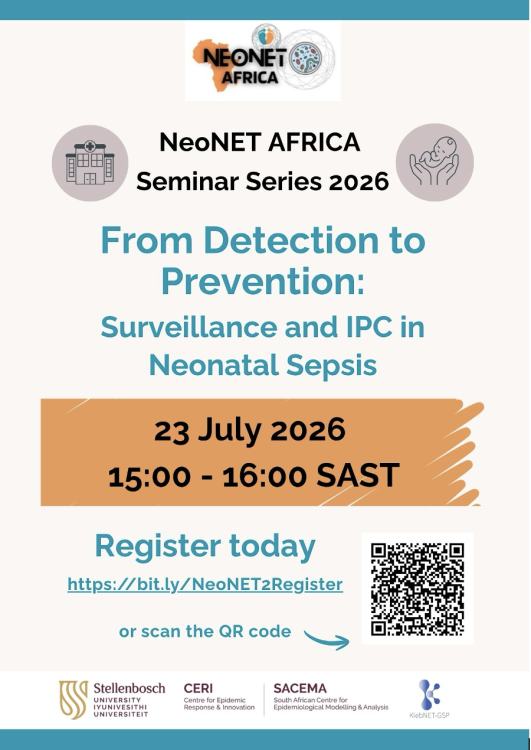
Dear colleagues, NeoIPC asks you kindly join the next instalment of the NeoNET Africa Seminar Series 2026: From Detection to Prevention: Surveillance and IPC in Neonatal Sepsis 📅 23 July 2026 🕒 15:00 – 16:00 SAST 💻 Online 🔗 Register here This one-hour online session brings together leading experts across Africa to explore how surveillance data can drive effective infection prevention and improve neonatal sepsis outcomes. Seminar Programme Highlights: Chair – Dr Felicity Fitzgerald (Imperial College London / The Health Research Unit Zimbabwe) Lessons learned in setting up neonatal sepsis surveillance in African Hospitals – Dr Christina Obiero (KEMRI-Wellcome Trust Research Programme, Kenya) Use of an IPC bundle to reduceKlebsiella infection in three hospitals Uganda – Dr Victoria Nakibuuka (Nsambya Hospital,Uganda) The NeoIPC toolkit: simplifying surveillance for healthcare-associated infections in neonates globally – Prof Angela Dramowski (NeoNET AFRICA / Stellenbosch University, South Africa)
-
until
Dear colleagues, Dear colleagues, NeoIPC invites you to join next NeoNET Africa Seminar Series 2026: From Detection to Prevention: Surveillance and IPC in Neonatal Sepsis 📅 23 July 2026 🕒 15:00 – 16:00 SAST 💻 Online 🔗 Register here This one-hour online session brings together leading experts across Africa to explore how surveillance data can drive effective infection prevention and improve neonatal sepsis outcomes. Seminar Programme Highlights: Chair – Dr Felicity Fitzgerald (Imperial College London / The Health Research Unit Zimbabwe) Lessons learned in setting up neonatal sepsis surveillance in African Hospitals – Dr Christina Obiero (KEMRI-Wellcome Trust Research Programme, Kenya) Use of an IPC bundle to reduceKlebsiella infection in three hospitals Uganda – Dr Victoria Nakibuuka (Nsambya Hospital,Uganda) The NeoIPC toolkit: simplifying surveillance for healthcare-associated infections in neonates globally – Prof Angela Dramowski (NeoNET AFRICA / Stellenbosch University, South Africa) -
Hi Gustaf thank you for the first and very important question in our neoIPC club section. Brar Piening who is responsible for infection prevention and control at Charité's Campus, will help us look into this question. Im sure he has a boarder view compared to neonatologists in this field. Have a nice weekend, Annika
-
Dear Antoine, This is a very important topic, and I can say in advance that practices differ between countries. I will try to present the Estonian approach here, which applies in most centers dealing with high-risk newborns: We do not perform routine bacteriological analysis at any gestational age. We only analyze breast milk if the infant develops a clinical problem – such as signs of sepsis or feeding difficulties, etc. In Estonia, we try to follow Swedish donor milk bank guideline thresholds, which were originally and historically established for breast milk intended to be given raw. An important aspect here is that this approach is individualized and depends on gestational age. First, we assess the overall clinical picture. https://www.milknet.se/ We do not routinely check maternal seropositivity. We think that ~80% of them are seropositive. Holder pasteurization is performed only if there is a diagnosis of congenital or acquired infection. Our protocol is relatively liberal, and we believe that a mother’s own raw milk is the best for own child. One center freezes maternal breast milk for 72 hours to reduce CMV presence, but it is known that this method does not eliminate CMV. I hope it helped. Looking for other opinions! Best Annika (Tartu, Estonia)
-
Thank you for this excellent topic. I struggled with this a few days ago and came to the conclusion that we also need adequate resources within the perinatal center. At a moment we use synbase.ee and lactmed.com. OpenEvidence is very good source to find latest evidence. I’ll add a good article reference here that will help us look at the topic more broadly Best, Annika I MOBM.pdf
-
We have our "inside" agreemets regarding the observation of the newborn. When the pH is <7,0 - monitoring in skin-to-skin contact, neonatologist check-up and repeating the analysis after 2 hours if clinical pic is ok. When the pH is < than 7,1 - monitoring, repeating the analysis and neonatologist if needed. Some of my colleagues discuss about ICD code in those cases and document it as fetal distress. Im not sure its necessary...
-
I have a question regarding international codes. If a baby is born with low umbilical artery pH, but the Apgar score is normal, adapts well, pH/ BE/ lac normalizes, amniotic fluid is clear, and there is no multi-organ failure. Would you code it anyway P20.1 (fetal acidosis alone)