
_0b6494.png)
_5c07e1.png)
_0d1bd3.png)
_75149d.png)
(26).png.c97dc453b63ee0a4658a82af0237d93f.png)
We're triplets, not twins
By Nicholas Embleton in Neonatal Butterfly Project
· 270 views
I want to share parents and siblings’ stories of love and loss, to raise awareness of the complex and lifelong nature of baby loss, and to help healthcare professionals better understand some of what parents feel. We will never really know what it feels like, but listening and reflecting makes our jobs more rewarding, changes the way we act and behave, and helps us provide better support to parents.
Genevieve contacted me via the Butterfly project website after she received a purple butterfly on a NICU, and she has been kind enough to share her story below.
Genevieve Howell - Keira, Kendall and Hannah
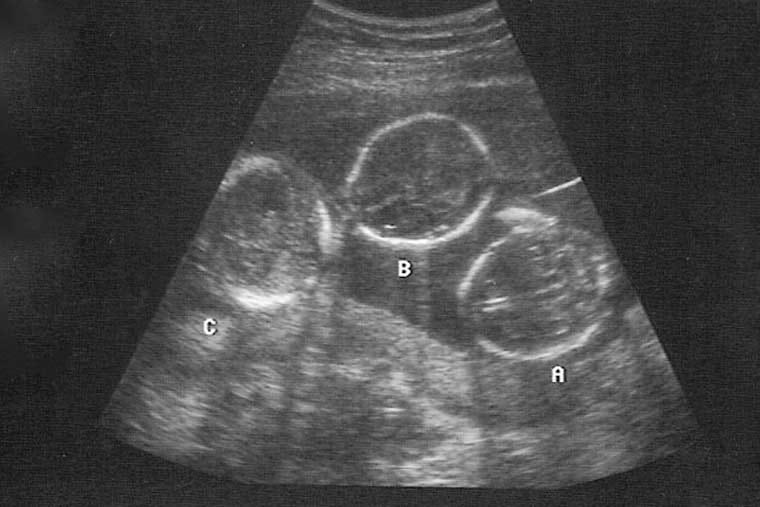
I will never forget the moment the sonographer describing what she could see on my first ultrasound… three babies - triplets! I can still feel the shock when I recall this memory, with this being something I had never anticipated or even imagined before. It didn’t take long for my mind to be filled with questions, with so much feeling unknown.
Credit: https://ambadyscan.com/blog/anomalies-in-triplet-pregnancy/
Soon after that first appointment, we attended the fetal medicine unit (FMU) where we learned I had spontaneously conceived dichorionic triamniotic triplets – three babies, three sacs, and two placentas. The babies sharing a placenta would be identical.
I couldn’t believe it – what an amazing, beautiful gift to have such a miracle pregnancy, and for all those babies to have started to form and grow, together. I felt incredibly lucky, and still very much in shock.
After a lengthy scan, a serious appointment followed, discussing my ‘high risk’ pregnancy, selective reduction, a plan for a c-section, and the risks of things like ‘twin to twin transfusion syndrome’ (TTTS) and the triplets being likely to be delivered much earlier than the already adjusted limit of 35 weeks of pregnancy.
Lots of appointments but the messages from health professionals were positive – the babies and I were doing well.
Due to spontaneous labour, my triplets were born at 31+1 days. Hannah was born first, weighing 4lb 1oz, followed by Kendall who weighed 3lb 10oz, and then Keira weighing 2lb 14oz. There were lots of people in the delivery room, and there was an air of excitement. However, soon after Keira was born the atmosphere in the delivery room quickly changed. I know now that Keira struggled to breath after birth and was resuscitated and needed to be put on a ventilator in the delivery suite.
Within minutes of their arrival, each of my babies was whisked past us from the delivery room to a different room each in the neonatal unit - Keira in Room 1, Kendall in Room 2, and Hannah in Room 3.
Life changing news came too soon. We were told that Keira had a condition called congenital diaphragmatic hernia (CDH). We had never heard of this condition and did not know what it was, however, we were about to quickly learn. Keira’s lungs had not been able to fully develop due to a herniated diaphragm, which meant she was fighting for her life.
We never got to the surgery we initially hoped for to repair the hernia, and Keira died after 10 hours and 5 minutes. Keira was my first baby that I held, looked at, talked to and sang to. She was perfect and our moments together are those I treasure more than anything.
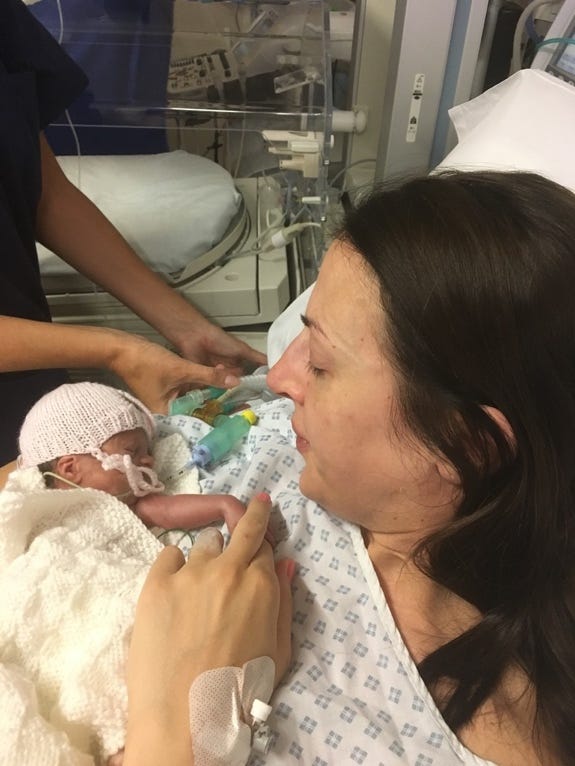
Keira (triplet 3) – born at 02.44. This was our first time meeting in ICU, when we had already learned that she was not going to survive.
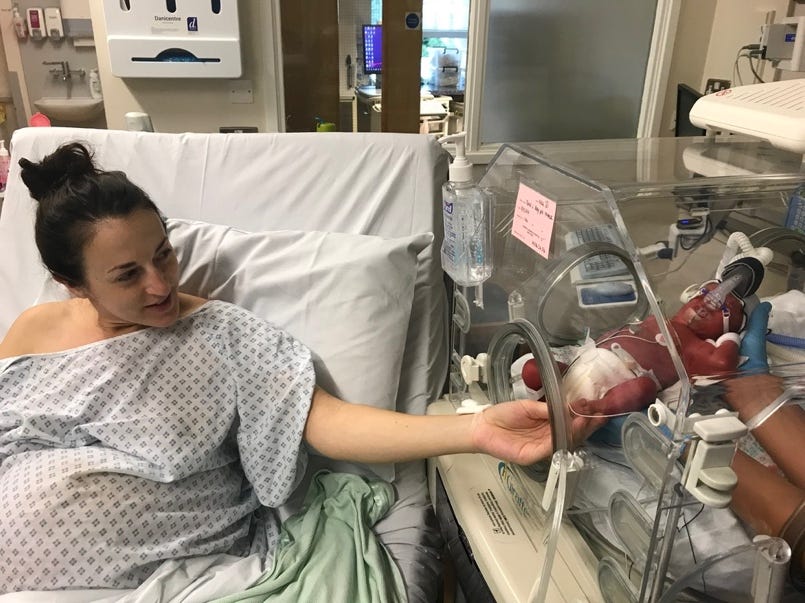
Kendall (triplet 2) – born at 02.44. This was my first time meeting her in ICU on the day she was born at 17.48.
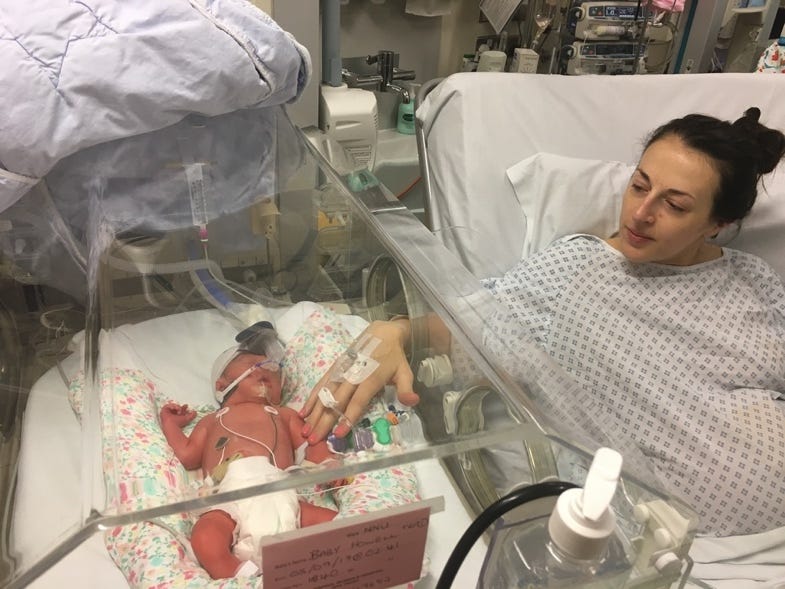
Hannah (triplet 1) – born at 02.41. This was taken at 17.53 and was my first time meeting her in HDU.
For the next 5 days we stayed in a bereavement suite that enabled us to have Keira with us and spend time with her in those early days of shock, loss and grief.
We were shown indescribable kindness and compassion from everyone who came into our room and I was touched by those who asked if they could see and meet Keira. As well as needing time with Keira, we also had our survivors, Hannah and Kendall, without us on the neonatal unit, both relying on treatment and care for their own survival.
Amongst the many feelings I had, I was frightened, and I no longer knew what to expect. No one was supposed to die, yet Keira was gone. Outside of the bereavement suite I felt exposed and scared that I’d need to explain, or I would be expected to say and do things that I could not.
I was frightened. No one was supposed to die, yet Keira was gone
With the news of Keira’s death, a little purple butterfly was placed on the girls’ incubators. We learned that this signified that each baby was part of a multiple birth where not all the babies had survived. The purple butterfly gave me a sense of safety and comfort in a dark and excruciatingly painful time. It was my hope for protection against one of my initially devastating thoughts – that people would view Hannah and Kendall as twins, when they were not, and they would not know about Keira, who was here too and just as important and precious as them.
I wanted everyone to know Keira. To know she was here, that I loved her, that she should have stayed. I wanted to say and hear her name that I had chosen for her. I also wanted to be a mother to each of my babies, who needed me in different ways. My surviving babies, and my baby who had died.
One of my initially devastating thoughts – that people would view Hannah and Kendall as twins, when they were not
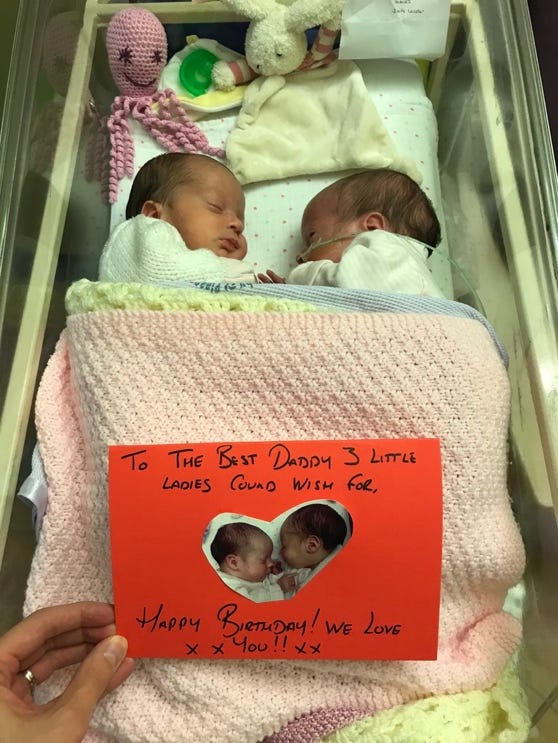
An example of staff keeping Keira in mind when making a card for Dad.
Everything had changed. I suddenly needed to learn to express breastmilk, change nappies through incubator windows, learn a new medical language, how to tube feed, and get to know my babies, all while processing tremendous loss. The purple butterfly stayed by our sides, and I believe was the facilitator for helping me feel my situation was understood as much as it could be, and for encouraging others to treat us all with care and compassion.
For the 9 weeks that Hannah and Kendall were cared for on the neonatal unit, Keira remained in the care of the bereavement team. I was able to spend time with Keira in the bereavement suite and took comfort in knowing she would leave with us. I couldn’t think of having Keira’s funeral without her sisters. And I couldn’t believe her sisters were going to live until we were discharged from the hospital. After 63 days we left on the same day, and a few days later we had our funeral for our girl.
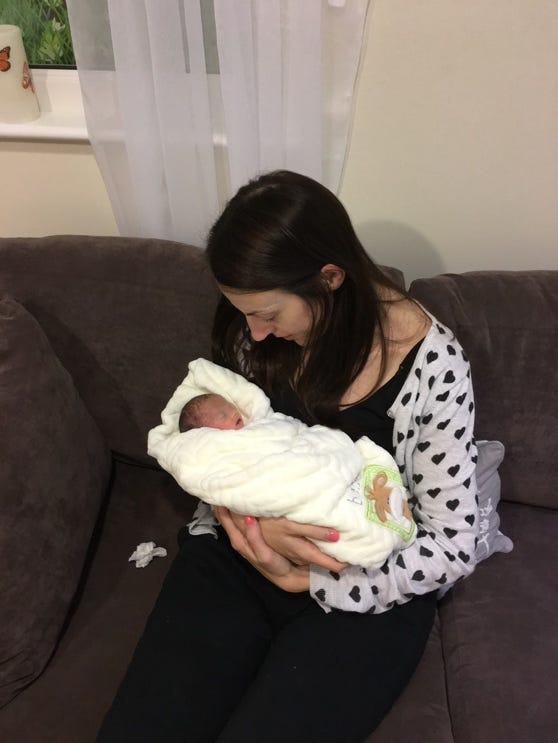
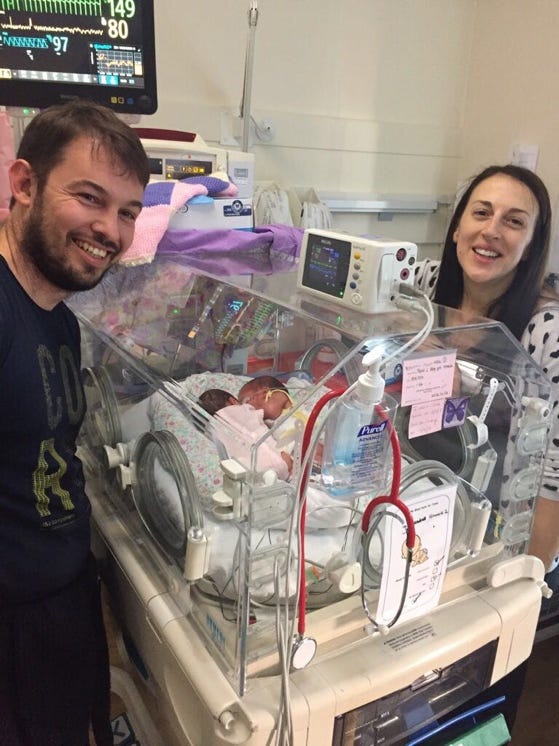
These photos were on the same day – spending time with Keira in the bereavement area in the hospital, and later in HDU finding that Hannah and Kendall were finally in the same room and together for the first time since birth.
How I missed that purple butterfly after Hannah and Kendall were discharged from the hospital and we went home.
Having two babies attracts a lot of interest from others, meaning I could not really go anywhere without people commenting and most often asking, ‘are they twins?’. Every time this hit me like a bullet, and was so incredibly painful. I found going through the medical system was not met with the same sensitivity that we had experienced in the neonatal unit at times. Hospital appointments were difficult, with staff asking questions like ‘where is the other one?’ which occurred on multiple occasions and was truly so devastating and challenging to deal with at that time.
Hospital appointments were difficult, with staff asking questions like ‘where is the other one?’
Over the years I have found my own way of responding to comments and questions, and have found strength that helps me to overcome the sense of shame I have felt to simply say ‘they are triplets, and one of my daughters has died’.
I have learned to understand that the shame is not mine to bear, nor is the comfort of other people with my truth.
I have learned that it is down to me to educate other people about situations like mine.
When it was time for my girls to start nursery, and then again with starting school, it was important to me to explain to the staff that Hannah and Kendall have a sister called Keira, and they are triplets. This was important to me as I wanted to advocate for them and their identity, and I was keen for them to have a good and clear understanding of themselves and their family. I knew that they may talk about Keira and wanted staff to know who they were talking about so that they could respond with context. I have some fond memories of staff telling me how the girls talked about Keira, and felt I was met with understanding and sensitivity during the early years of nursery.
One of my earliest thoughts when I was saying goodbye to Keira, that she wouldn’t get to go to school, and I wouldn’t get to take her there
Preparing for starting school was a challenge. It was one of my earliest thoughts when I was saying goodbye to Keira, that she wouldn’t get to go to school, and I wouldn’t get to take her there. So, like I had in the years up to that point, I carried the loss of her not being there alongside the joy and anticipation of my survivors starting school. I believe I was met with kindness and compassion from the reception class teacher, and our wishes and experiences have been considered at school in the most part. Although looking back I know this was such a painful and lonely time for me as well as it being incredibly difficult to know how best to deal with this situation for everyone.
it was such a painful and lonely time for me…There’s always a pair of shoes missing at the front door
I think it would help for educators and professionals to understand that for us, there’s a part of our family who they cannot see but is very much present in our lives. She’s on our photographs at home, in our memories, hearts and thoughts. But there’s always a pair of shoes missing at the front door, and a smiling face missing on every photograph of my children and family. Every milestone, achievement and happy time is accompanied by enormous loss and sadness. Every school play, performance, parents evening, report. Every first, every last. Managing both is exhausting and unavoidable, as both occur through love which will never fade.
Now my survivors are 8 years old, and I’m proud when they say ‘we’re triplets’, because they are and always will be. I know that as they grow and develop their thoughts and feelings about their sister and their own identity will change over time, and this might be something they need the adults around them to understand and support them with.
***
Nick Embleton
The purple butterfly idea came from a bereaved parent during some of the workshops we ran after our research studies. We had spoken to lots of bereaved parents, and staff, and conducted our thematic analysis where we identified several themes. When the bereaved mother suggested placing a butterfly on the cot of the surviving babies, it seems such an easy and logical thing to do. It was just saying ‘this baby has it’s own unique identity’.
The importance of “identity” really struck me when I first worked with sociologists. Looking back, if I’m honest, I’m not sure I had ever really thought about the term prior to the early 2000s, or what it meant, but we’ve come to realise how important identity is in all it’s socio-cultural dimensions.
I’m not a sociologist or psychologist, but I see identity as the intersection of how you think about yourself and how the world views or categorises you. Identity is clearly multi-dimensional and changes over time, and for all of us acknowledgement is key.
For children (or adults) born as part of a multiple pregnancy where one or more babies die, the importance of identity emerges at many different points, from conception and early life as embryos, and then throughout the life-course. Many parents struggle with knowing how to maintain and project that identity to others. Most surviving lone twins or triplets (and in that I include higher order pregnancies) maintain a very strong twin/triplet identity throughout their life. In the case of Genevieve, and other triplet/quad families, this can be even more challenging. Many bereaved parents told me how they were often upset when walking down the street with two babies, and the endless congratulations from onlookers on their “twins”.
Genevieve has unique insights into how schools treat children like hers, and how they can be educated to better support families like hers. We have been working together with various advocacy groups on guidelines which we will share here in the future.
Thanks for reading, please share and subscribe and feel free to share your thoughts.
* * *
Recommended Comments