



Gandhi & neonatal nutrition

By Nicholas Embleton in nutrition
· 24 views
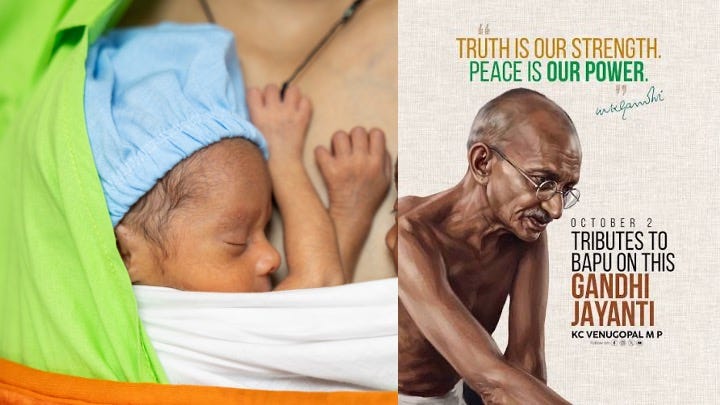
Gandhi is universally admired and respected across the world as one the most inspirational political figures campaigning for independence and civil rights in both South Africa and India; lands that were colonised and ‘stolen from’ for centuries by British rule.
By chance I am in India today, on Gandhi’s birthday (Jayanti). I’ve been privileged to present at workshops and give lectures at conferences and NICUs, and been invited to join ward rounds and discuss various aspects of neonatal nutrition. A common challenge is ensuring adequate growth, sufficient electrolyte intakes and maintaining serum concentrations especially those <1000g. Promotion, and use of, Mother’s Own Milk (MOM) is universal across India, and many NICUs in privately run facilities also now operate their own donated human milk banks. Some NICUs are also being approached by mother’s experiencing baby loss, to offer their milk in memory of their baby who died (Lactation after Loss), the topic of one of my workshops.

The Salt March of 1930, led by Mahatma Gandhi, is one of the most transformative events in India’s struggle for independence. Gandhi and followers undertook a 240-mile march to the Gujarat coast on the Arabian/Indian sea. Salt is an essential nutrient, especially in hot climates where losses through sweat are high. It had been traded for centuries before the British imposed the Salt Laws, which made it illegal to collect or sell salt which was heavily taxed and controlled. Gandhi recognised that taxing an essential biological nutrient was an extreme act of colonial oppression affecting every Indian. Raising this issue was a masterstroke of political strategy that crossed societal boundaries. Salt taxes disproportionately penalised the poorest and highlighted the moral bankruptcy of colonial rule.
Salt & evolution
Everything in biology is explained by evolution. Hundreds of millions of years ago, life originated in the primordial oceans and the first single celled and early multicellular organisms developed in a highly saline environment, from which all cellular processes depended on the surrounding sea water. When animals migrated out of the sea, they couldn’t leave the ocean behind and developed complex renal and hormonal metabolism to enclose that ancient ocean.
Salt is essential for human survival, regulates fluid balance, nerve transmission and muscle function. It is one of the most critical nutrients for preterm infants, who are born prior to the 3rd trimester when sodium is accumulated as ‘osmotically inactive’ sodium reserves in bone, skin and other tissues. This may help compensate for the relatively low [Na] in MOM. However, most people on the NICU are far more interested in ‘sexier’ nutrients like protein, DHA, zinc etc. and salt needs are rather under-appreciated.
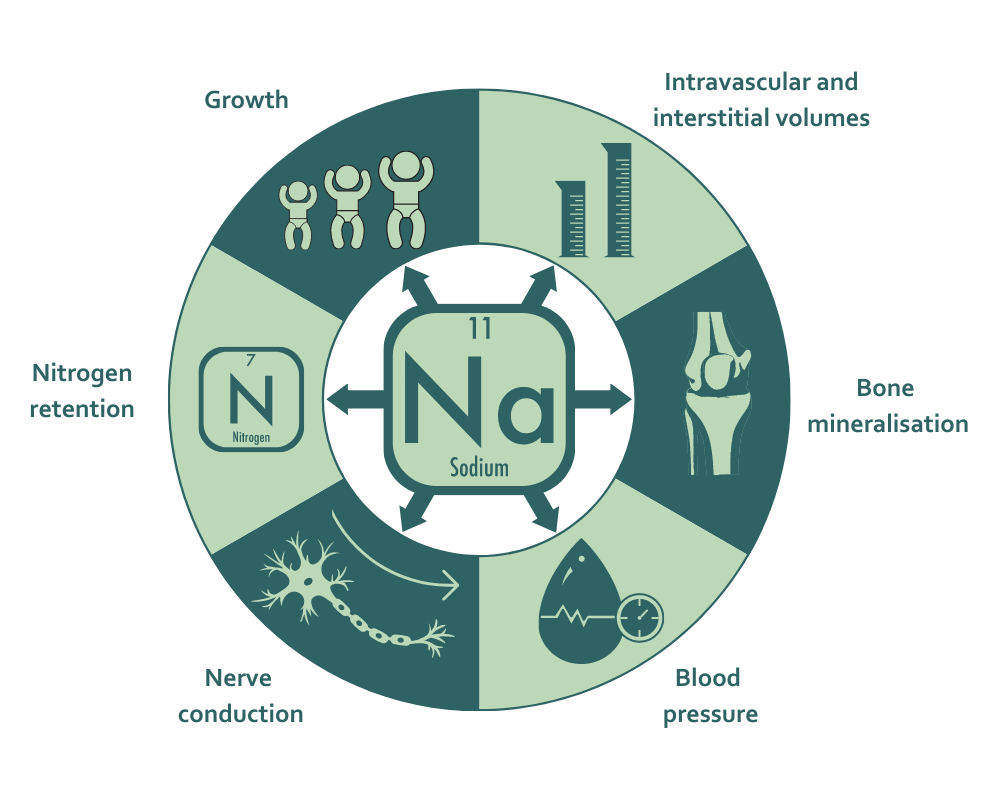
Preterm infants have a high requirements for sodium due to several factors including:
limited body stores
high growth rates
renal tubular immaturity
low sodium concentration in human milk
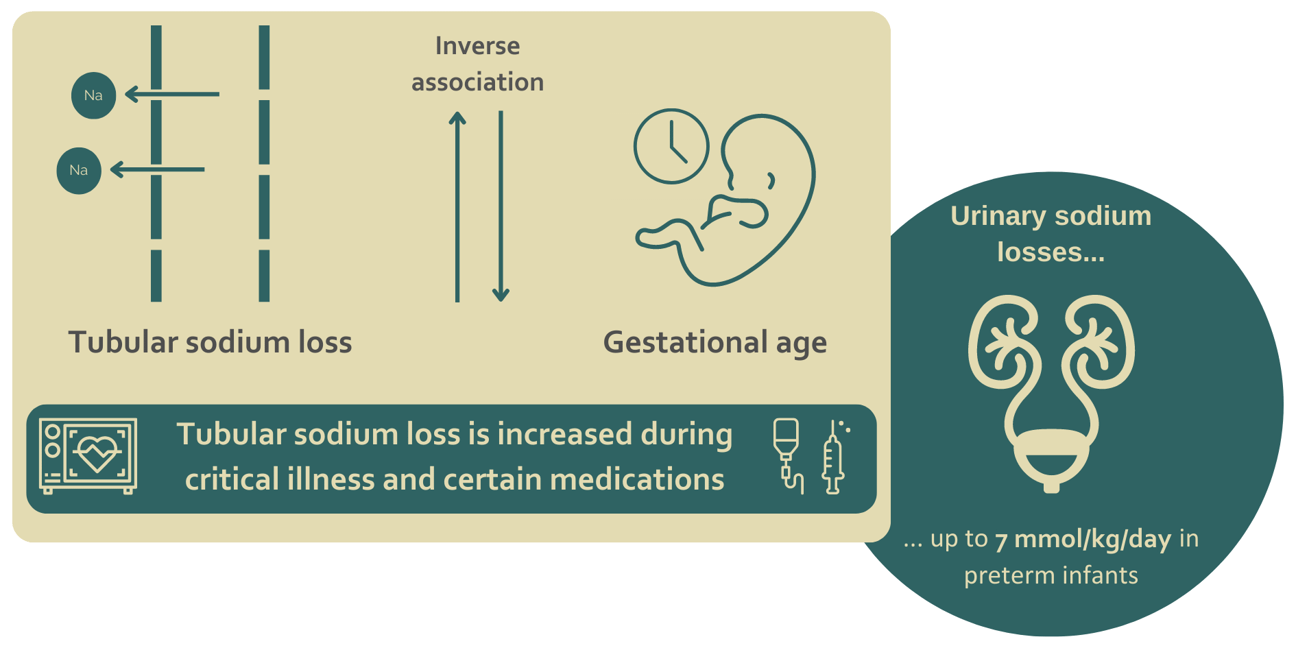
Sodium potassium pumps in every cell maintain the electrical charge across cell membranes enabling nerve transmission and muscle function, and help maintain osmotic balance and blood volume. Term-born infants only receive/need around 1-2mmol/kg/d sodium in MOM, but preterm infants require much higher intakes because of rapid growth and urinary losses. Fractional excretion of sodium (FeNa) is typically high.
Salt concentration of early milk and colostrum is higher, but most preterm infants only receive small volumes. There have also been concerns that adding too much sodium to PN in the first 1-2 days may provoke fluid retention and worsen later BPD. High [Na] in the first 2-3 days are also common and may represent excess trans-epidermal water loss, prompting many to believe that additional sodium is not needed.
Serum sodium - common mistakes
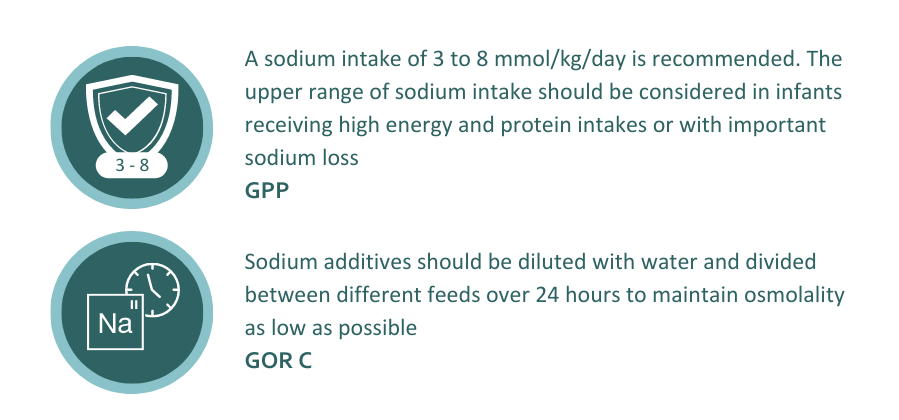
Blood/serum [Na] measures the concentration of sodium and not the total mass, as most sodium is extravascular in the interstitial tissues and also bone. A normal serum sodium can mask massive sodium depletion. Once the baby is total body sodium deficient it can be very hard ever to catch up, and all of us have witnessed infants where we keep prescribing i.v. corrections to no avail. When we updated the ESPGHAN guidelines in 2022 we noted that many very preterm babies need more than than 3-5mmol/kg/d previously recommended, and suggested intakes up to 8mmol/kg (or occasionally higher) might be needed.
Clinical practice
Because sodium is vital for both nerve function and growth, it makes sense to provide recommended intakes in the first few days rather than wait for [Na] to drop. It’s analogous to meeting macronutrient intakes with fortifier or formula before waiting for the baby to experience growth faltering. ‘Prophylaxis’ is the key.
Do higher salt intakes improve outcomes?
Whilst there are no well powered large RCTs, the accumulating evidence suggest sodium intakes are important for growth and perhaps brain development. There is little point giving optimal intakes of protein and calories, if there isn’t sufficient sodium to accrete into lean tissue.
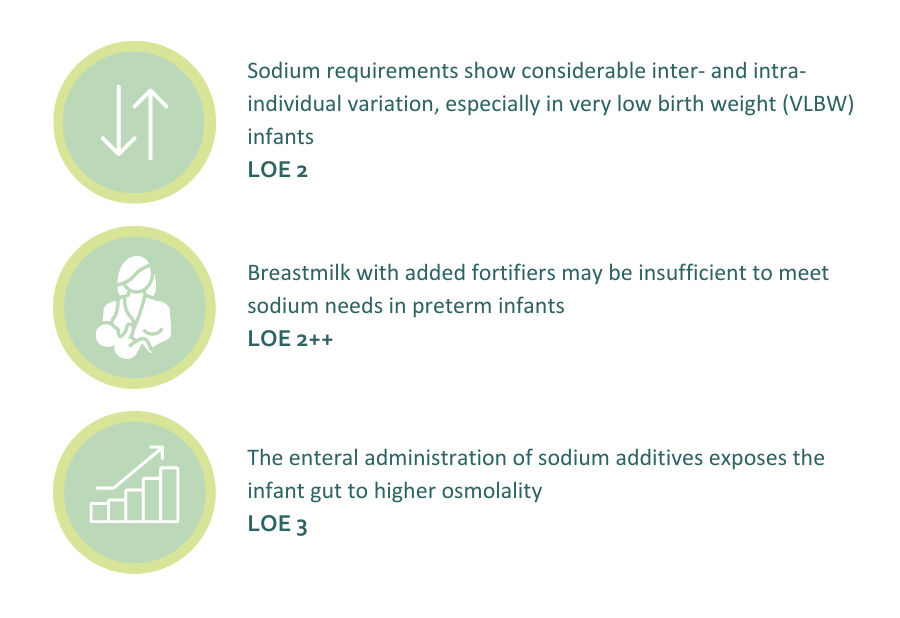
Conclusions and recommendations from ESPGHAN are summarised below.

-
 1
Recommended Comments