




#mypapers - It matters where extremely preterm infants are born (#2)

By Stefan Johansson in mypapers
· 24 views
My journey to a PhD was not easy, but it eventually led to a set of descent publications. And a thesis too :)
First, a failure...
In the late 1990s, I got involved in research about water balance in preterm infants, and its implications for PDA treatment. My task was to collect urine samples from preterm infants. As you can imagine, this was not very easy but nice nursing colleagues helped out. I sometimes still wonder if those urine tubes are still in some freezer at the Karolinska Campus... To my knowledge, no publication ever came to life. Or at least no publication I was co-authoring…
Anyway, this led to a Big Idea about studying ibuprofen for PDA closure, early targeted treatment, the flavour of these days. There were a few promising papers back then suggesting that ibuprofen was better tolerated than indomethacin kidney-wise, and that it worked equally well to close the duct. Being young, naïve, full of energy and without respect for much, I designed a large national multi-center RCT on my desk :)
Unfortunately, it gradually became evident that the idea was far too big. The small research team did not have the competence for this kind of trial, and ibuprofen for iv use was not even available at the time... In the end, a few years of work all went into the recycling bin.
When I got involved in writing that paper about those infants being water intoxicated, my firstling [link], I got connected with some really good people who helped me into a regular PhD research training. I am especially glad about the mentorships by prof’s Sven Cnattingius and Mikael Norman. In short, they helped me into a new research trajectory, in a way I keep being mostly grateful for.
...leading to the first paper in my PhD
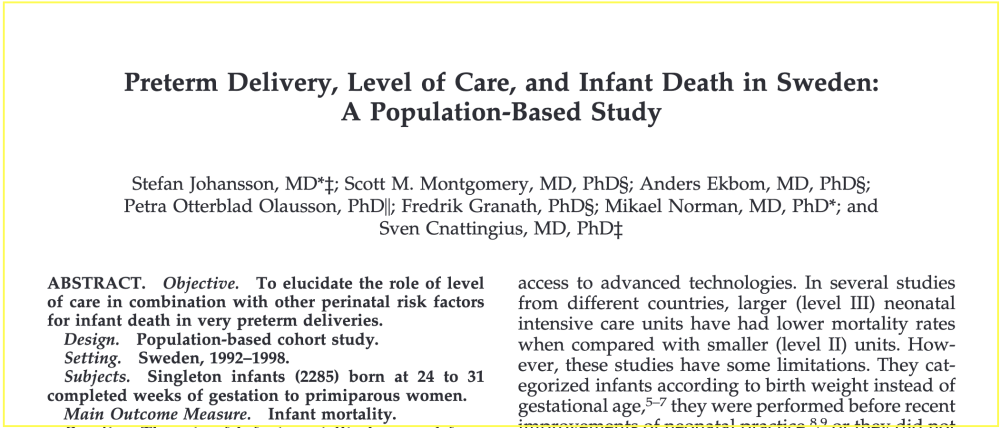
In 2004, I published the first project in my thesis-to-be. Based on data from the nation-wide Swedish Medical Birth Register, it investigated whether level of care (birth hospital) influenced survival in 24-31 week preterm infants.
Interestingly, the initial results were somewhat counterintuitive. But, they also served as a good learning example of the importance of addressing confounding.
Overall, mortality was lower among infants born at general level-2 hospitals (10%) compared with university level-3 hospitals (14%). The main reason was, of course, that university hospitals cared for a considerably larger proportion of the most immature infants, with a higher mortality risk.
When we accounted for gestational age and confounders, a different picture emerged. Among infants born at 24–27 weeks of gestation, mortality was 23% at university hospitals and 32% at general hospitals.
When we computed relative risks, adjusting for gestational age and other perinatal factors, the risk of infant death were about twice as high among extremely preterm infants born at general hospitals (adjusted OR 2.00; 95% CI 1.15–3.49; BTW, today I think odds ratios was a less good way to express relative risks within this cohort, with high baseline risks. Not wrong but less good).
In contrast, among infants born at 28-31 weeks, we found no difference in mortality between hospital types, which was also a re-assuring finding, since those infants are meant to be cared for in level-2 hospitals in Sweden.
I hope our findings contributed to the body of research supporting regionalisation of neonatal intensive care. IMHO, this organisational principle, centralising extremely preterm birth to larger regional centers, remains central to in modern neonatal intensive care.
And perhaps the most important message was the following: improving neonatal outcomes is not only about developing better treatments as such. Outcomes after preterm birth is also about how health care is organised.
Reference:
Johansson S, Montgomery SM, Ekbom A, Otterblad Olausson P, Granath F, Norman M, Cnattingius S. Preterm delivery, level of care, and infant death in Sweden: a population-based study. Pediatrics. 2004;113(5):1230–1235. DOI: 10.1542/peds.113.5.1230
Citations:
Per Google Scholar 2026-11-20: 127 citations
Recommended Comments