
_0b6494.png)
_5c07e1.png)
_0d1bd3.png)
_75149d.png)
(26).png.c97dc453b63ee0a4658a82af0237d93f.png)
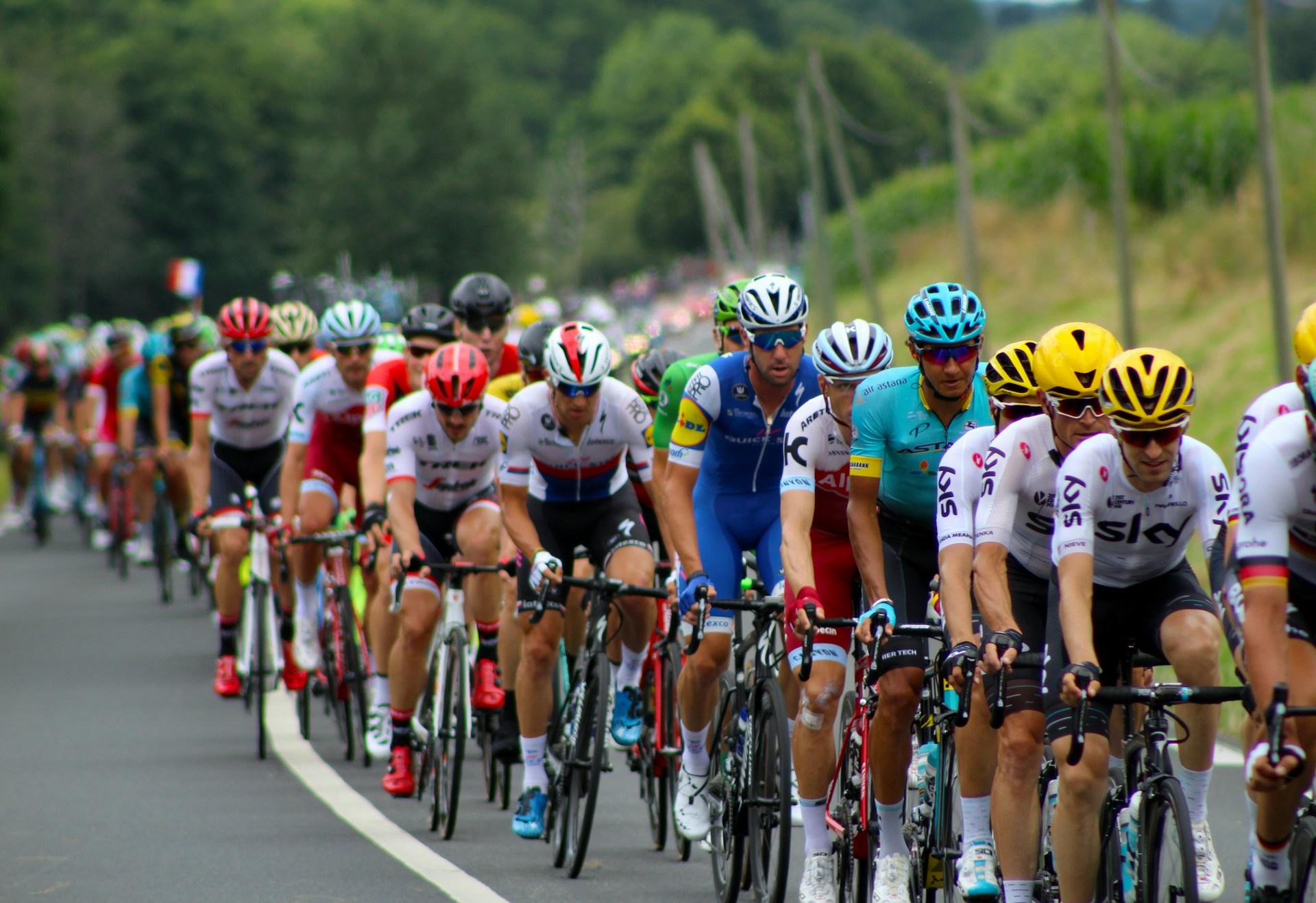
Preterm infants need more energy than cycling the Tour de France
By Nicholas Embleton in nutrition
· 876 views
Previous posts described that very preterm infants ex-utero are ‘programmed’ to grow at a similar rate to the fetus before birth, gaining about 2g/kg/day of protein (as well as gaining fat, water, minerals etc. etc.). A 25 week infants increases her birthweight by more than 400% (500g to 2500g) over 3 months of NICU stay. Thankfully, that rate of weight gain isn’t sustained into early infancy and protein needs dramatically reduce as the fetus/baby approaches term.
We don’t want adult sized toddlers, right?!
Breastmilk alone cannot meet protein needs of very preterm infants on the NICU, although high volume feeds and other supplements may ameliorate some of the growth faltering we commonly observe. We’ll discuss approaches in another post.
Energy needs are dramatic. Using different theoretical approaches, most estimates are that total energy requirements in preterm infants are around 120kcal/kg/day on average. Compare this to Colombian cycling legend Egan Bernal who won the Tour de France in 2019. He weighs around 60-70kg and during ‘le Tour’ consumes around 6,000-7,000 Kcal/day. Imagine how wonderful it would be to consume that many calories without getting fat?
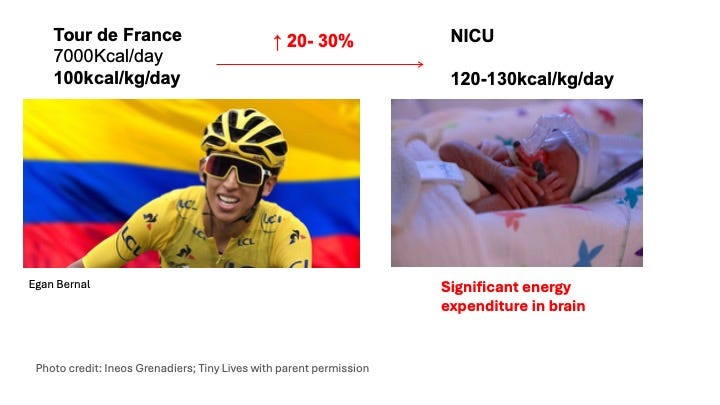
If you estimate energy requirements you can see that very preterm infants need more energy, than the energy required to cycle up and down mountains. Some of that energy in preterm infants is expended in wriggling about, but that only accounts for a small fraction. A small amount of energy is also expended in heat production - more if you don’t keep them warm with KMC or incubators.
Most of the energy is ‘used’ in two ways
(1) being converted into energy stored in tissues (fat, protein, glycogen etc.) or,
(2) accounted for by the energy consumed by “Basal Metabolic Rate”, or BMR.
BMR is effectively the energy required to run all your vital functions and cellular systems at rest, including brain, cardiac and respiratory activity, sodium/potassium pumps in every cell, hepatic production of proteins etc. BMR actually doesn’t vary that much during the NICU stay - it’s around 50kcal/kg/day. Heat production and activity are around 5-10kcal/kg each per day, meaning there’s around 50kcal/kg/day remaining to be stored as protein and fat.
BMR doesn’t really alter (except during acute illness when it’s not by definition ‘basal’), nor can you stop babies moving, breathing, heart pumping or trying to keep potassium inside their cells. That all takes around 60-70kcal. Simple maths will show you that giving 100kcal/kg/day, which sounds like a good amount, means you’re only making 30kcal available for tissue deposition. A seemingly small deficit of 20kcal.
The problem is that the ‘first’ 70kcal you give has to go to BMR (and movement and heat.) You are then only meeting 60% (30/50) of the energy needed for growth. Growth faltering is pretty common even when you think you’re doing a good job. Which of us could maintain our weight on 60% of predicated needs? Though there are a few who could risk giving it a go.
Failing to give enough macronutrients to a preterm infants is also very common and often avoidable; seriously, why would you not give enough? And if body growth is slow, maybe brain growth is also slow, and maybe some of the long-term neuro-cognitive sequelae of preterm birth are more common… It’s difficult to see how any of this can be good, despite a few sceptics telling us not to worry about growth, and the experts who tell us there’s nothing more dangerous than an expert.
Human brains are massive
It is the human brain that distinguishes us from every other mammal including other primates. It is huge and it requires lots of energy to develop and function. Throughout pregnancy neurones formed in one part of the body need to migrate to their final destinations (NEURONAL MIGRATION) ready to perform critical brain functions.
At birth babies have all the neurones they will ever need - about 100 billion. But, they are not wired together very well, and that process of SYNAPTOGENESIS takes a huge amount of energy over the next 2 years. In the first few postnatal months, babies form 1,000,000 synapses per second! If we gave a term infant 40% less energy I expect he would have to down-regulate synaptogenesis. If you are not impressed by that stat feel free to unsubscribe and watch England lose on penalties to Germany. Synaptogenesis is especially active in the visual and auditory cortex of course. We can see it coming.
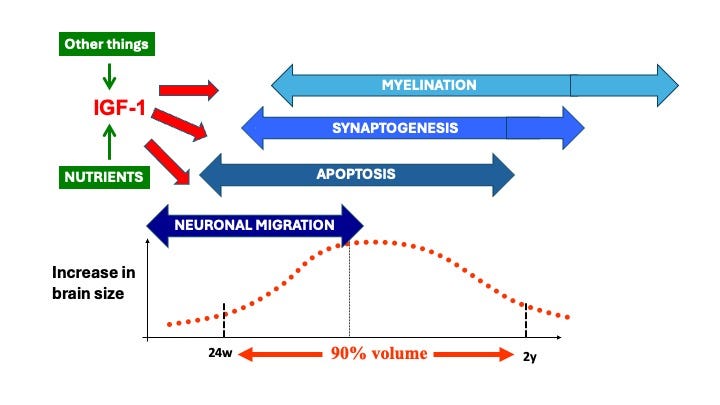
We can discuss apoptosis, synaptic pruning and myelination in other posts.
Although it is difficult to precisely measure, it seems that about 50-60% of energy expenditure in healthy newborn infants over the first months is the brain. Growth has slowed from fetal life, thankfully, and diets have low protein but energy demands are high. Whilst protein seems to dominate nutrient requirements as a preterm infant on the NICU, after term age ENERGY becomes most important, and all efforts focus on this. Lots of lipids, lactose in milk, and just enough protein to form the cells and support slow growth.
As adults, the brain represents about 20-25% of energy expenditure but we do not know what % it is for preterm infants. Synaptogenesis is starting slowly in the second and third trimester, and whilst I used to think the brain might represent 50% of all energy in preterm infants, I suspect the true figure is much less, as proportionately more of the energy is needed for lean mass accretion. Maybe it’s only 20-25%, who knows? Either way, it’s significant, and failing to meet energy needs, or observing growth faltering must cause concern about the adequacy of macronutrient supply for the brain.
Brain growth and differentiation is so complex we won’t ever understand it. We would need an even bigger brain to understand it, which would then be even more complex to understand … catch 22. What we do know, is that these processes are under the control of multiple hormones, especially IGF-1 (Insulin like growth factor 1). IGF-1 concentrations ex-utero are pretty dismal compared to in-utero (50-80% lower), and whilst some companies are investing millions into trials of synthetic supplemental IGF-1 the data to date are underwhelming. There is however, some evidence that macronutrient intakes (energy and protein) modulate IGF-1 concentrations providing a potential mechanistic link between diet and brain differentiation and growth.
Back to breastmilk.
Mother’s own milk, especially fresh (i.e. warm), is life-saving for premature infants and the most cost-effective in all of medicine.
Prove me wrong. All medicine, not just neonatal. Donated human milk has lost many of it’s functional benefits through storage, pasteurisation and transport, but is still associated with lower rates of NEC even though it doesn’t seem to reduce surgical NEC or mortality (another post needed there). This might be because although heat permanently alters protein structures (antibodies etc.) it has much less effect on small sugars (HMOs) which may be a key component in reducing NEC risk.
Human milk with <1g/100mL will never meet protein requirements in extremely preterm infants. But for energy, the equation differs. Human milk has around 65kcal/100mL albeit with substantial variation between individuals and stage of expression, and usually much lower in DHM. This means that feeding MOM at 180-200ml/kg/day will meet energy needs in most very preterm infants (but won’t meet micronutrient, mineral, vitamins needs etc.) DHM at 200ml/kg/day won’t meet needs.
Protein is the problem. Preterm babies need more protein than from MOM alone. If energy was the problem, we could solve it more easily.
Where can we get more protein?
We’re surrounded by a key element for the diet, nitrogen. Preterm babies breathe more nitrogen in and out than oxygen, and have at their finger tips (well alveoli) the core element for building amino acids. Why don’t they wake up, smell the coffee and use it? Caffeine citrate is, of course, odourless which might be part of the problem.
Nitrogen is the core element of amino acids, amino acids make proteins, and proteins make prizes … but humans (like all mammals) are incapable of turning atmospheric nitrogen into amino acids. Nature didn’t think it necessary. Shame. How disappointing to watch a sick preterm infants on a ventilator, being given all the nitrogen it could dream off, being ‘expirated’ 0.3 seconds later before it could be fixed.
We need plants or insects which animals can eat, which we can then eat, or consume their milk. Theoretically, we could get extra protein from non-animal sources (seaweed, plants, bioreactor bacterial synthesising proteins) but that won’t be available this decade (but I am predicting that next decade milk-identical protein will come from a bioreactor). As of 2026, the protein preterm babies need has to come from another animal, and whether you like it or not that’s going to be a cow in the global majority. I could though write another post on human milk-protein-derived products if you want?
Please subscribe to these posts and the Baby Loss posts from the Butterfly project. Some of the email sign-ups end up in junk mail folders so check there. Feel free to comment and spread the word. I’m open to questions, but can’t promise to answer them.
-
 1
1
Recommended Comments