


UNSCRIPTED: a story of baby loss, identity, and how pop culture saved my life
By Nicholas Embleton in Neonatal Butterfly Project
· 24 views
Elaine wrote a post “I didn’t want twins” a few weeks back which received 1000s of reads, and I asked if she would share more of her story.
This is an extract from UNSCRIPTED, a detailed exploration of the experience of prematurity and baby loss.
But it is not ‘just’ a baby loss memoir. Through wide-ranging cultural touchpoints, Elaine offers an acute and authentic exploration of the grief we also experience when our lives take a wholly unanticipated turn. She unapologetically presents the essential truth that we do not need to be brave or strong or change who we are in order to come through trauma, arguing that we can find a new path by drawing on the things that made us who we were before the tragedy occurred. It’s also a love story with real resonance between Elaine and her husband Mark as they navigate their loss and new life together.
‘Labyrinth’
In my single room on the Maternity Ward, there’s a clear plastic crib. Hip height, secured in a steel frame and resting on swivel casters. A crib where new babies sleep next to their mum.
I have no baby and I stare obsessively at the empty vessel mocking me.
I wait for someone to take it away. But no-one does.
The room is basic, but clean. A single bed. A sizeable wooden fixture with a place to hang clothes and a shelf to deposit bits and pieces. A sterilising bowl on the window. That crib.
There’s a blue privacy curtain behind the door, to stop people seeing in through the window when you get undressed. My husband Mark pulls it closed as I manoeuvre myself awkwardly on to the bed.
Bloodied cannulas cling onto the wrecked skin by my wrists and the bruised backs of my hands with sticky tape that’s lost its stick. I stare at them in a trance.
They are violent reminders of the last eight hours.
I have given birth to twins. The twins are not here.
An unfriendly note attached to the wall screams that partners should NOT sit on the bed. But there is nowhere for Mark to rest his body, still in last night’s clothes. We were not supposed to be thinking about giving birth for four more months. We are not meant to be in the hospital. He tries to get some relief by leaning on the windowsill. I know his feet will be hurting.
‘We have to name them,’ I say.
I have no idea if the twins are alive. No-one has told us what’s happening, but I cannot bear the thought of two unnamed dead babies lying alone somewhere, so I grab my phone and scroll through the list we had recently constructed. Finn. Riley. Roman. My eyes dart through the names we had had tentatively put on the ‘maybe’ list. Theo. Bertie. Barney.
Mark suggests we take a name each.
I say Henry. He says Blake.
We send messages to our closest friends.
We do not say ‘mum and babies doing well’ or ‘so in love!’ Instead we make ominous statements about ‘taking it hour by hour’ and ‘no news is good news.’
I focus on Mark’s face, pushing my tongue against my bottom teeth.
‘We will not let this destroy what we are,’ I say. I don’t know if I’m saying this out loud, or if it’s in my head. ‘I will not let this crush us.’
I can feel my swollen belly, bereft of its load, as fluid oozes through the back of my hospital gown. After some looking around, Mark discovers an opened pack of sanitary towels in a cupboard. With one in hand, very carefully and tentatively, I half-roll off the bed and shuffle towards the bathroom door a few steps away. I have a bathroom attached to my room. At least I don’t have to go outside.
The bathroom doesn’t have a bath. It’s a windowless cavern with tiled walls and a metal shower head protruding from up high. At the far end, there’s a toilet. At the other end, a broad rectangular plastic pedal bin sits next to the drain in the ground that will take the stained shower water away.
I hold on to the cold wall as I press the pedal bin’s foot plate. I don’t know why I’m looking inside, or what I expect to see.
The lid rises cautiously and I spy thick pads rolled in tissue. Red-brown blood has soaked through. Remnants of the women before me. I wonder if they had wrapped their bloody towels in toilet paper as their baby cried in the plastic crib.
I take tentative steps towards the toilet. The seat is black, hard and uninviting. The idea of having a wee is terrifying. I lift up the gown and slowly place my bum on the seat, sending shocks through my body. My feet barely touch the floor.
Then it dawns on me that something weird is going on.
There are two doors on the wall facing me. Door 1, next to the bin, leads me back to my room. It’s how I entered the bathroom. The other door goes… somewhere else.
I fixate on the handle for Door 2. Is it locked? What on Earth is on the other side? Will someone walk in when I’m on the loo?
I hear the voice of a goblin inside my head.
‘One of us always tells the truth, and one of us always lies,’ the goblin says in a Scottish lilt. In my mind’s eye, I can see him guarding Door 1.
‘He always lies,’ the Scottish goblin continues. He nods to another goblin guarding Door 2.
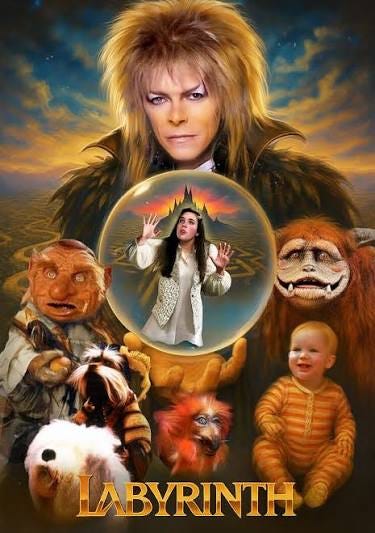
Two doors. Two goblins. A riddle. My traumatised brain has shown me Labyrinth, the cult 1980s movie, famed for Jim Henson’s wonderful puppetry, and, let’s be honest, David Bowies’ very tight leggings. I am Sarah, the young protagonist, who must solve the maze in thirteen hours and rescue her baby brother Toby from the Goblin King. In my madness, I’ve superimposed a scene from the film - where Sarah is faced with two doors, goblin guards, and a riddle - into a shower room in a hospital whilst I dangle on the toilet for the first time since giving birth to babies who may not be alive.
In Labyrinth, one door leads to the castle where Toby is being held. The other to certain death. Despite owning DVD and Blu-Ray versions of the film, and watching it incessantly throughout my life, I have never understood what the answer to the riddle is. I’ve never known whether Sarah gets it right or walks through the wrong door.
When Sarah enters her chosen door, she falls into a hole. As she tumbles down, she’s caught by sentient hands sticking out of the walls. Helping Hands, they’re called. The hands group together to make faces with moving mouths and expressive eyes. They ask Sarah which way she wants to go: up or down. Given that she’s heading in that direction, Sarah opts to go down.
‘She chose down?!’ the hands shriek. They let go, and she falls into the darkness of the shaft until she lands at the bottom, ending up in a dungeon with no exit. An oubliette. A pit to forget.
Before my mind has the chance to replay the scene again, I sense stirring behind the door that absolutely does not lead back to Mark. Some shuffling at first. The soft banging of cupboard doors. Voices. And a baby’s snuffling cries.
Door 2, it appears, leads to another single room with a mother and baby inside. I’m in a shared bathroom.
The goblins vanish. The riddle is over. I’ve fallen into the oubliette.
The blood drips from my body into the toilet bowl. I type ‘24 weeks gestation survival rates’ into the search bar on the Google app on my phone. Within a fraction of a second, the internet gives me this:

‘Babies born at 24 weeks don’t always survive. And if they do, their quality of life is typically limited. They are likely to be blind, deaf, and wheelchair and oxygen bound for life.’
Hours pass. I wait in my room, with my shared bathroom and empty crib, until someone comes to give us a leaflet about the neonatal unit. Inside, there is a warning not to use mobile phones in the unit, as they may interfere with the equipment.
Emerging from our room for the first time, so begins the excruciating misery of passing other people. Mothers and babies in the corridor. Families cooing over new bundles in the relatives’ room. A departing car seat with an ‘it’s a boy!’ balloon bouncing along behind.
A sadist has designed the hospital. Parents staying on the ward have to make the journey down the world’s longest corridor to get to the neonatal unit. Our grim looks and tightly held hands tell the story. A new mum with slippers that slap the floor puts her head down and moves quickly away. This is not a place for anguish and tear-stained faces.
No-one wants to think about dead babies on a maternity wing.
We can’t walk straight into the neonatal unit. We stand there, exposed, outside the door, pressing a security button. I stare through the panes of glass, wondering if anyone will come. Wondering what might be happening. Trying to catch someone’s eye. I think about getting in the car and driving far away.
‘We’re here to see the twins. We’ve had twins. The twin boys,’ I say into the metal box.
We are buzzed in through the first set of doors. The walls are full of photos of children who have previously been on the unit. One little boy’s pictures are accompanied by a plaque. He’d died some years later.
Another set of glass doors. The room is shadowy with flashes of dim blue light. I can just about make out equipment and people walking around with concerned industry. I can hear muffled rhythmic beeping and then loud alarms. ‘Beep, beep, beeeeeeeeep.’
We are guided inside.
Henry and Blake are in two separate incubators at the back of the room. I don’t pay them any real attention, because I am consumed with making my way to the trough-like hand washing station. I’ve been told to wash my hands thoroughly.
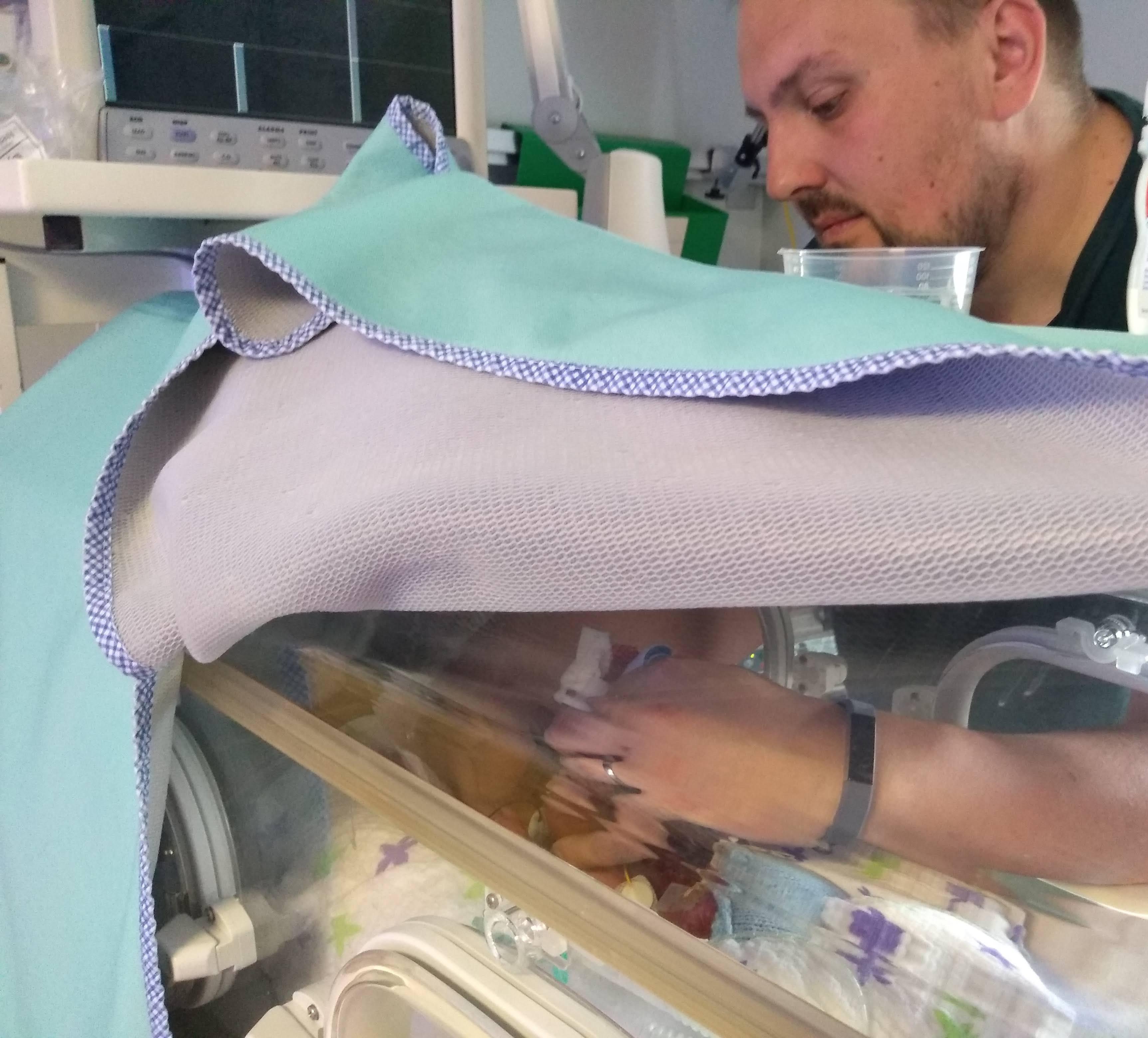
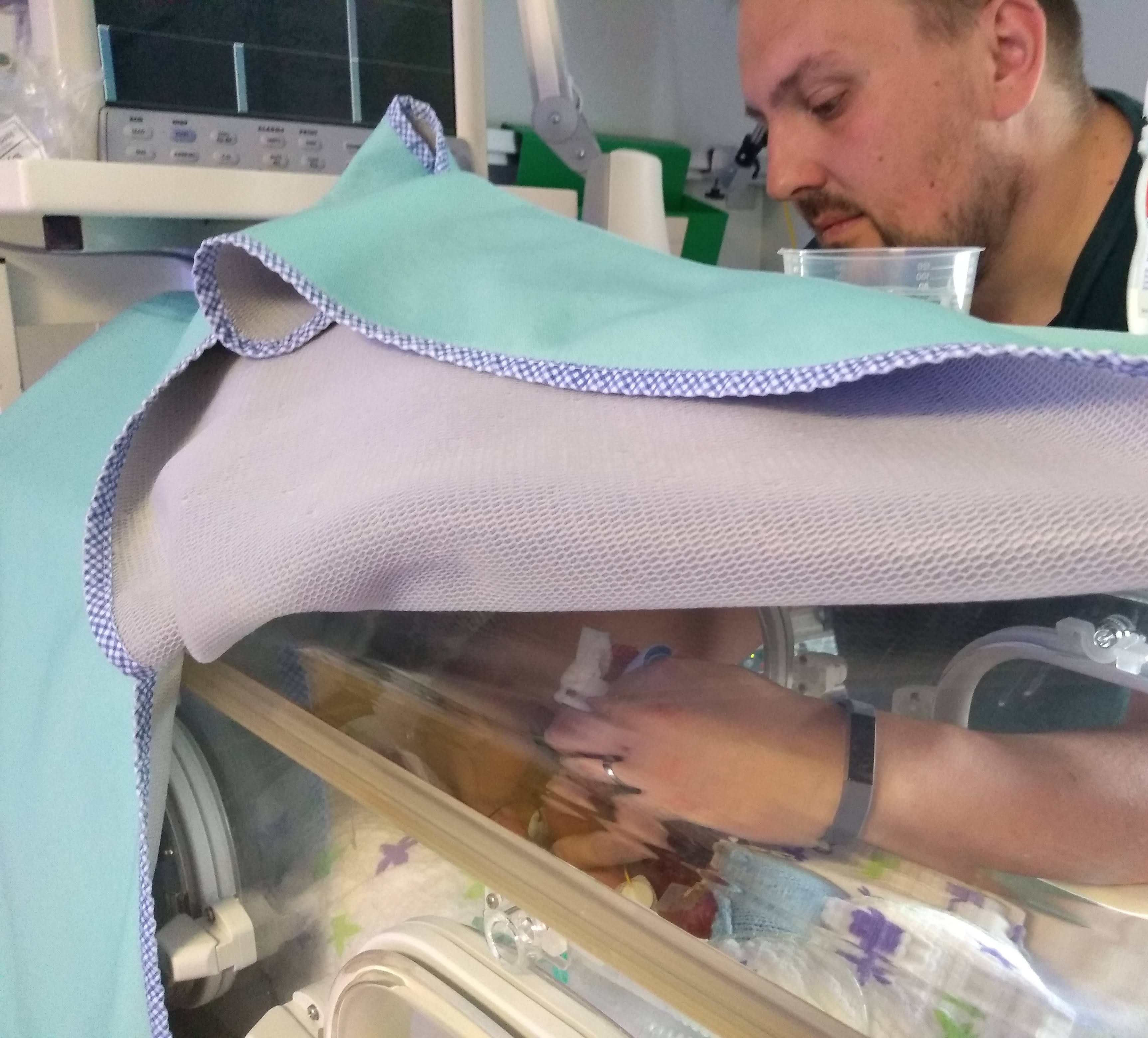
The room is a perfect square. Doors at one end. Handwashing trough at the other. A row of incubators line up against the remaining two walls, divided by the nurses’ station in the centre. Some incubators are covered with a thin green sheet. It is dark and unnaturally warm. There is constant beeping. And machines. So many machines.
I wait by the end of Blake’s incubator and try to listen as a group of doctors surround us with a quiet kindness. Neonatal nurses silently pad from one side to the other, diligently checking numbers, wires and tubes. They record every breath, every movement, every alarm from the machines.
I hear the words. Henry and Blake are alive, but very unwell. We need to take it hour by hour. They are stable, for now.
Clutching my mobile phone in hand I hastily take a photo of Henry, then Blake, through the thick plastic of their incubators. The boys are wrapped in small transparent bags - the kind you keep leftover food in and throw in the fridge.
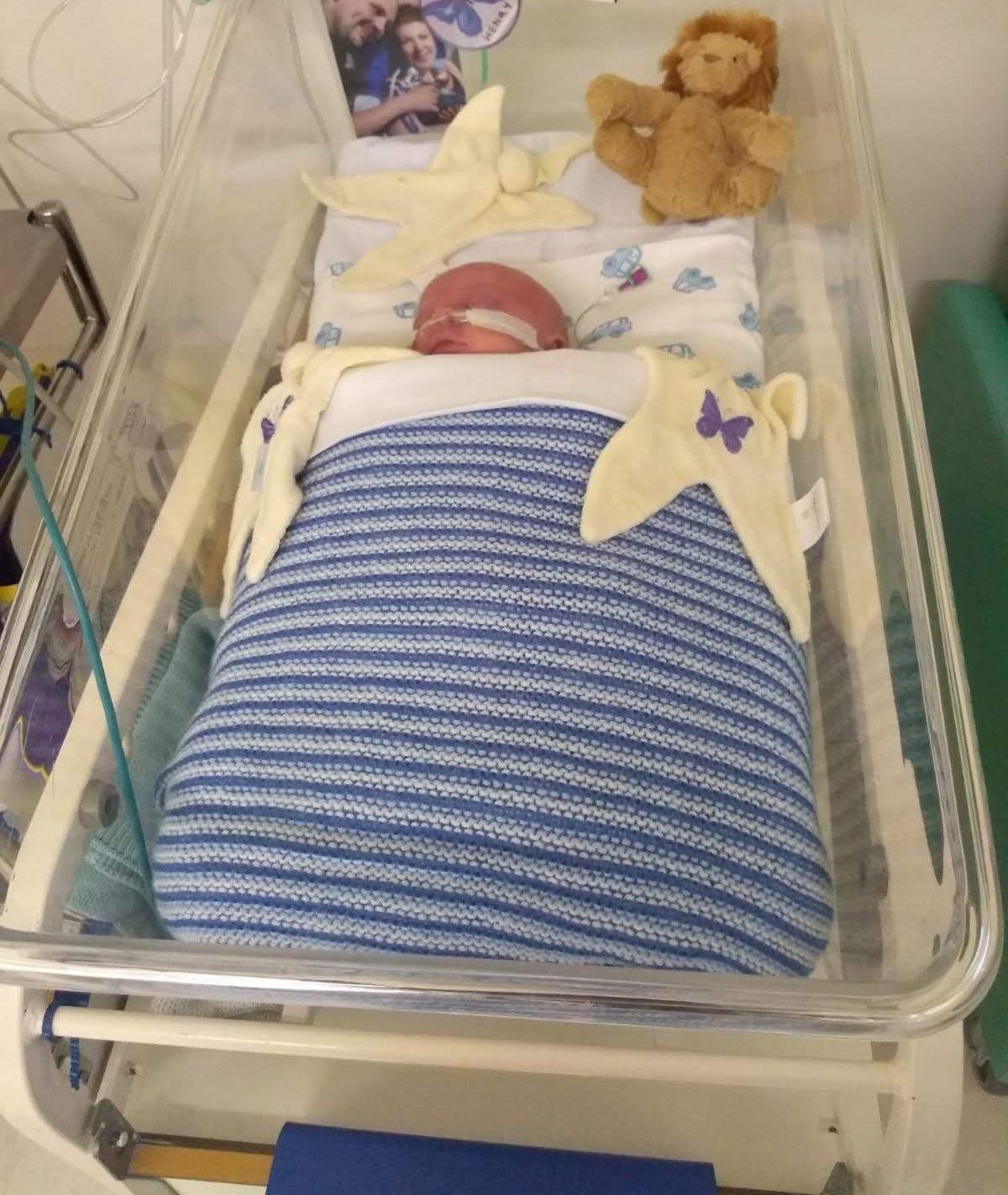
Henry is barely visible inside his crinkled plastic bag. A yellow woollen hat covers his miniature skull, right down to his nose. I can make out two silk threads securing his hat to a plastic clamp tight across his mouth keeping the breathing tube in his throat. The tube sends air into his lungs and makes them expand and contract in steady rhythm.
Henry rests on a plump cushion, hollowed in the middle, upholstered with pure white cotton covered with purple butterfly motifs. The butterflies circle his naked bruised body, knees bent up. His skin is so thin it’s barely there. He is the length of my hand.
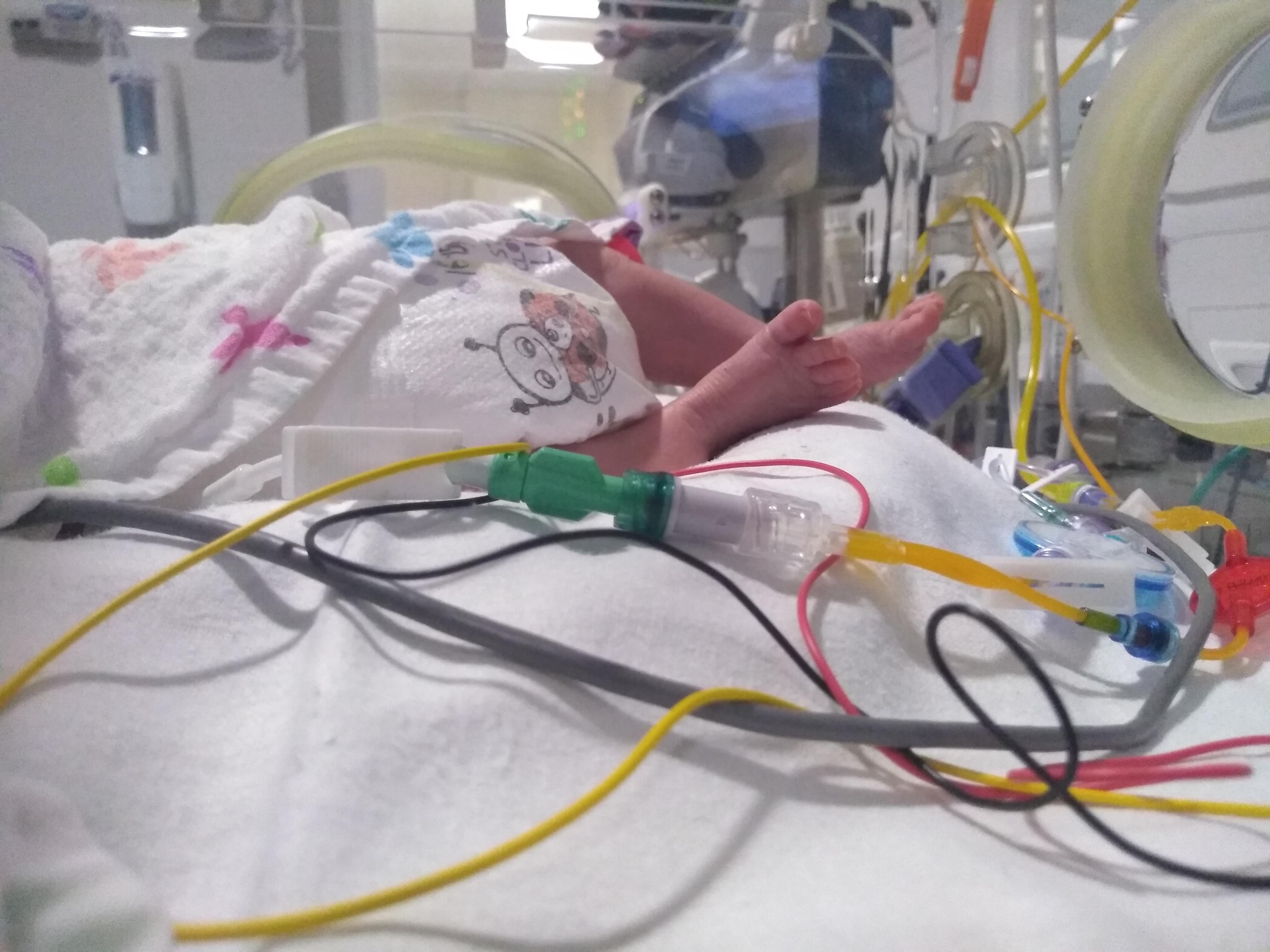
Blake is wearing a blue woollen hat but it does not cover his eyes. They are swollen and shut. A thin white tube protrudes from his nose. He is also fully ventilated and his chest is swamped by two heart monitors, each with a smiling cartoon bear’s face. His feet are black and have no definition. They look like they’ve been pummelled, like plasticine clumps.
Every now and then I spot a movement. A twitch of the leg. A minuscule finger slowly finding the silk twirls hanging from his hat.
In my oversized nightdress, barefoot and bleeding heavily, I am so scared someone will tell me off for taking photos, I don’t steady my hands or sharpen the images. I take one photo and that is that.
Later, back in my room, I hear the rhythmic squeal of the newborn next door. Through the night, every time I creep to the bathroom I push the pedal bin open. I see my neighbour’s used sanitary towels. I place my tightly swaddled parcels next to hers.
Messages in the dark from one mother to another.
-- -- --
Recommended Comments