



Probiotics & NEC #1: which product (if any) works best?

By Nicholas Embleton in nutrition
· 24 views
One of the most contentious topics in all of neonatal medicine is the routine use of probiotics to reduce the incidence of NEC. The second most contentious topic might be human milk fortification (or donated human milk) - another series on that is needed!
Over 50 RCTs, 100s of observational studies and systematic reviews, and 1000s of opinion pieces and commentaries have been published. Some commentators feel it is ‘unethical’ not to use them; others are convinced we need more RCTs before we can use them safely and effectively. Many would like head-to-head trials to determine the optimal product and species. With no further large placebo controlled or head-to-head RCTs in the pipeline in high income countries (HICs) those who are not convinced by the existing evidence are going to be waiting a very long time.
Interestingly, a very large n=14,000 infant, WHO coordinated PROPS RCT is underway in LMICs. Preterm and SGA infants are included but it is uncertain whether results will be generalisable to extremely preterm infants in HIC settings.

In a series of articles on substack I want to provide a brief overview of studies 1997-2027. Each article will only be a 3-5 minute read, and will assume readers know the basics of NEC and probiotics. The study is aimed at nurses and physicians working on the NICU, but scientists and parents might learn something too! I’m not providing an in-depth critique of the many limitations of every study but I am happy to debate - put questions in the comments! I don’t get any money for this, have no conflicts with the probiotic industry and don’t have a lawyer.
I want to shed some light on the different products and species used. Why do some studies use Bifidobacteria, and others Lactobacilli? Are they equally effective? What combinations are best? Why does one of the most popular products contain Streptococci but no Lactobacilli?
Does that seem odd to you?
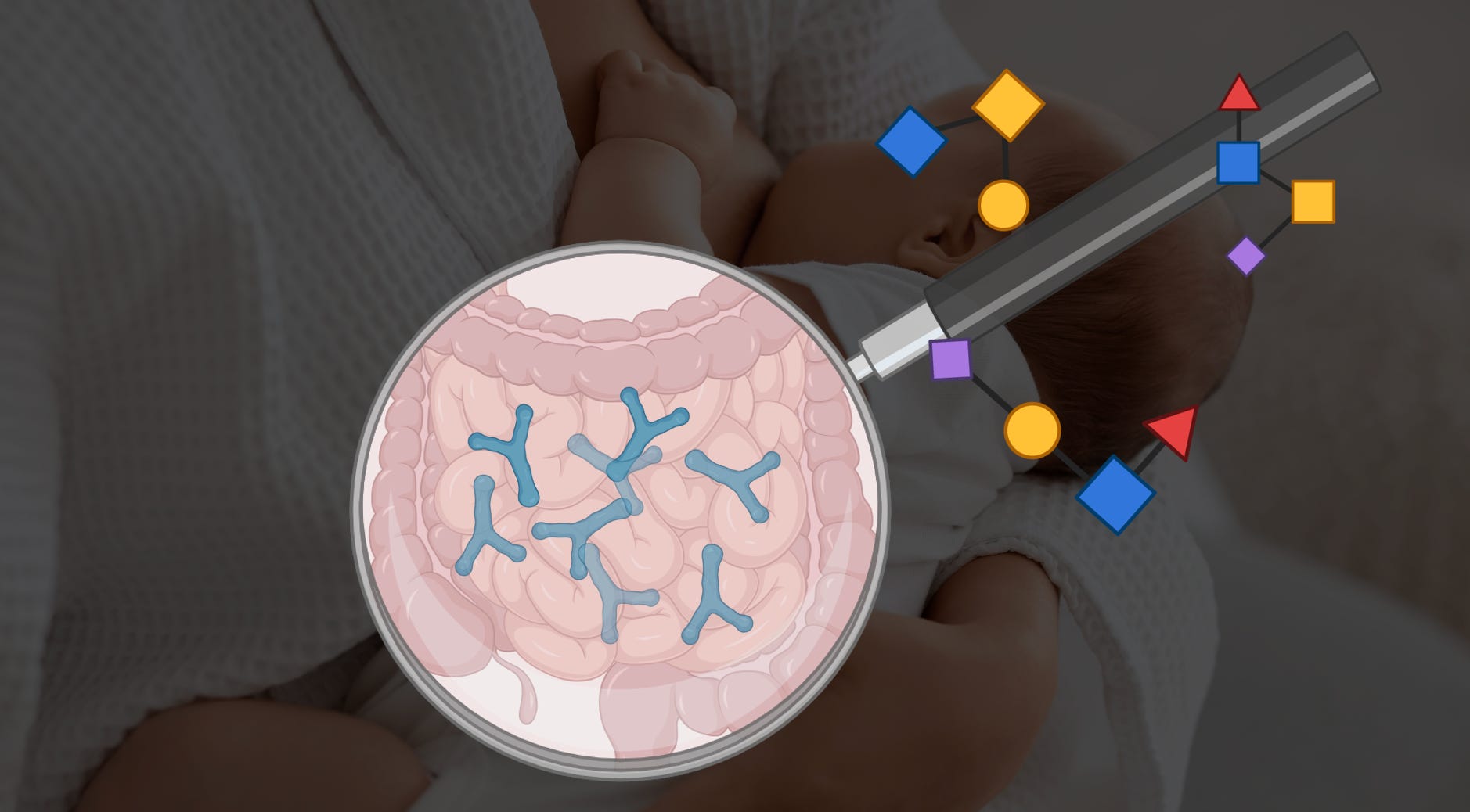
Many, but perhaps less than half of neonatal clinicians across Europe and the US are persuaded that probiotics are safe and probably effective but concerns persist about product QC and QA, and risks of product contamination. Without well tested, high quality products they pose a danger to life, and this is especially true in LMIC settings - I’ll write a separate article on that. Probiotic associated sepsis is very uncommon and rarely fatal in HIC settings, but still an important issue that needs greater understanding.
Understandable concerns about increases in the prevalence of antimicrobial resistance genes have not proven to be true to date, indeed more recent data suggest probiotics may improve the ‘resistome’. Cost is important in many settings, but in Europe, high quality products tested in RCTs are available for <10 Euros or US dollars per day, about 0.5% of the daily cost of NICU care.
When parents are informed about what we already know, most seem to want probiotics. Given the wealth of data supporting probiotics, I am still perplexed what parents are told in the 50% of UK neonatal units who don’t use them! I find it quite difficult to explain I-squared and Tau-squared meta-analysis statistics to myself, let alone an anxious parent. Given their low cost, and strong evidence of safety, I think it better to use them where affordable and high QC products are available. I also think that is fairer than try and explain to the parents of a baby with NEC that you believe the evidence base is insufficient and it was right not to give probiotics. Many parents of babies who die or get sick live with guilt and regret. Are our concerns and uncertainties so great about the risks of probiotics we are prepared to deny parents choice?
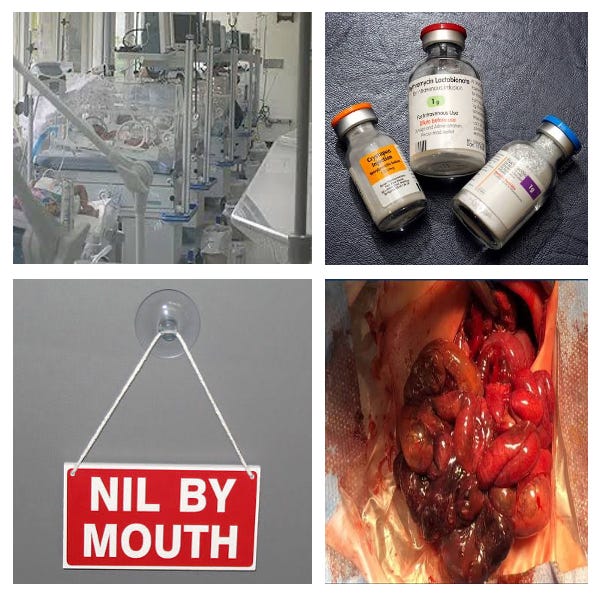
The FDA effectively ‘banned’ probiotic use in US NICUs in 2023 due to concerns about regulation, production and ‘inappropriate’ or unproven health claims, and followed a case of a preterm infant who died with probiotic sepsis. Whether the sepsis was causal or not in death is not clear. Whilst it is not difficult to understand and respect the modus operandi of the FDA, a series of before and after US observational studies conducted in 2024-2026 created by the ‘natural experiment’ of having probiotics abruptly withdrawn from the NICU, has shown dramatic increases in NEC following cessation. Until the FDA concerns are resolved, the data suggest that 100s babies might die from NEC over the next few years in the US.
Which product and why
In the UK and Europe, all products in widespread use are marketed as either health or food supplements, and none are considered pharmaceuticals. Provision to 10,000s infants over the last 5-10 years suggest they are very safe. National regulations or recommendations are not widespread. The only large, recently published RCT that was conducted according to pharmaceutical standards (Connection trial), did not show a significant reduction in NEC, although mortality as a secondary outcome was lower. The company who sponsored the trial has been in discussions with the FDA for many years in planning a high-quality trial, and it seems likely this will now lead to a commercial product. This would be the only probiotic product (L reuterii) with FDA approval, and given the FDA’s previous stance, the only product that would likely be licensed for use in the US in the next few years.
Is it the ‘best’ product, and should we use it? For what ‘indication’ on the label can it be licensed, and will clinicians be persuaded to use a product that doesn’t reduce NEC?
In this series of articles, I will describe the species and products used in the larger trials that shape our practice - UK PiPS, Australian ProPrems, trials in Taiwan, the Connection trial and many others. Were the individual species or combinations chosen because of their individual functional properties, their ‘synergy’ with other probiotics, or beneficial interactions in the ‘milk matrix’ in the gut? Does better understanding probiotic functions help explain why in some studies there is less NEC, but no impact on mortality, and in other studies the reverse seems true?
Is NEC a reliable and robust outcome in clinical trials?
Part of the challenge for all trials is that NEC is not a single disease, diagnosis is not always robust, and there is no universal agreed definition. False-negative and false-positive diagnoses may have confounded many of the published studies. Probiotics may be more or less effective than we believe. In most MA the RR for NEC is about 0.5-0.6 - I suspect the true effect in the real world is probably less, but even an RR of 0.8 would still be important and justify their use.
NEC has multiple risk factors and mechanistic pathways. The disease we see in 24 week infants on day 10 who typically have ‘patchy’ NEC at laparotomy is different to the extensive ‘NEC totalis’ we occasionally see at 6 weeks of age in a previously healthy fully fed preterm infant, or in infants with cyanotic heart disease. NEC or LOS that occurs on day 10, just 4-5 days after milk is started, is less likely to be reduced by an effective enteral intervention such as probiotics, than disease occurring a few weeks later. Probiotics will only prevent a fraction of NEC.
NEC is the end result of different processes, and is best conceptualised as the tip of the iceberg of ‘gut health’. In day to day practice on the NICU, we build a clinical picture of gut health by considering signs and symptoms of feed ‘tolerance’ (whatever that means!), abdo distension, motility, stooling, milk type, bloodwork, growth etc. etc. In the next 10 years AI will measure a multitude of parameters and synthesise gut health better than we can.
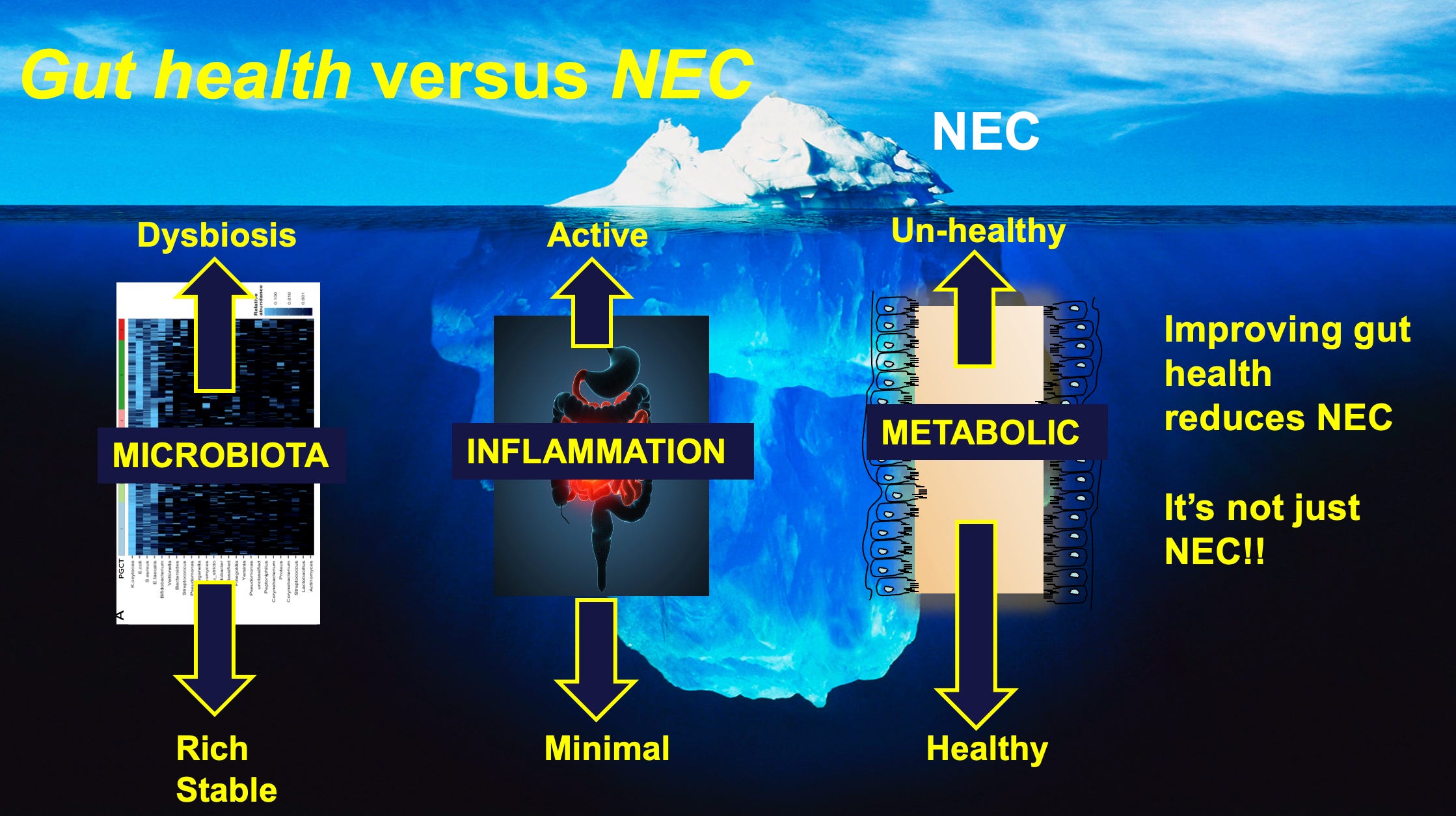
NEC is reported and recorded as a single disease, just like BPD or ROP etc. but these entities also do not represent discrete disease pathways. Our failure to reduce or prevent NEC in part is due to a lack of knowledge about mechanisms of disease, as well as a lack of knowledge of mechanisms of actions of potential treatments or other interventions such as human milk, probiotics and growth factors. We need much more granularity in reporting about NEC in trials and studies; rather than report that there '“were 27 cases of NEC”, electronic appendices could include [anonymised] patient level data including risk factors, age onset, blood work, surgery, histology etc. so readers can decide whether these really were what they understand to be NEC. “Bell stage 2 or greater” is not a robust outcome.
Evidenced based medicine
Kitajima et al. conducted the first probiotic RCT 30 years ago. In a small trial of n=91 preterm infants, they showed successful Bifidobacterium colonisation using Bifidobacterium breve BBG-01 (‘B breve’). The same species was subsequently tested in the UK PiPS trial (Costeloe et al.) but failed to show any significant impact on late onset sepsis (LOS), NEC or mortality. Since Kitajima in 1997, 60 further RCTs and numerous observational studies have been conducted and synthesised and appear to show clear benefits with less NEC, LOS and lower mortality. Standard MA has been rightly criticised: lumping RCTs using different interventions in a disease as complex as NEC has major limitations. Network MA (NMA) has also been conducted which allows a more refined approach to comparing products and was the basis of recommendations from ESPGHAN for using certain species and combinations. In the next article I will briefly review a historical timeline of probiotic RCTs. We can then focus in on the larger trials that had at least some power to determine impact on NEC.

RCTs powered on NEC as an outcome
Well, there haven’t really been any adequately powered RCTs with “proven NEC” as the primary outcome. Composite or dual-primary outcomes such as in the Connection study are challenging but it’s understandable why they are used. PiPS and ProPrems were powered on LOS. Given that a NEC diagnosis may not be robust, using NEC-surgery or NEC-mortality would be preferred. To reduce “proven NEC'“ from 5% to 2.5% with 90% power, and allowing for drop outs would require a trial of about 3,000 infants. Virtually all studies are under-powered and this creates challenges for MA.
In the next article I’ll describe the key RCTs over the last 30 years, focussing in on clinical impacts and the choice of product species.
-- -- --
Recommended Comments