_0b6494.png)
_5c07e1.png)
_0d1bd3.png)
_75149d.png)

-
I’m afraid practice varies between units and even within the same one. However, I can say that most premature babies won’t receive physiotherapy but babies with evolving or established BPD are more likely to. People get frustrated especially if there’s been no improvement in respiratory support like maintaining high oxygen levels or weaning PEEP. We’re a pretty impatient bunch in the NICU.
-
There is currently a lack of concrete evidence supporting the use of chest physiotherapy to aid secretion clearance and improve breathing in preterm infants, including those with BPD. This issue mirrors the ongoing debate surrounding NJT feeding in BPD. Furthermore, alongside the known risks of IVH, there are significant concerns regarding the potential for rib fractures, particularly in infants with metabolic bone disease.
-
Hi, A couple of thoughts from my experience. We have generally found transcutaneous CO₂ more useful for estimating/trending PaCO₂ in very preterm babies than end-tidal CO₂. One advantage of EtCO₂, though, is that you are likely to recognise a displaced or dislodged ETT much more quickly from loss or sudden change in the capnogram. This can be particularly useful in babies who are not sedated or muscle-relaxed. Transcutaneous CO₂ obviously has a significant lag in this situation. The other thing to consider, particularly in very small preterm babies, is the additional dead space. Depending on the equipment, the flow sensor itself may add around 0.8 mL, and adding an EtCO₂ adaptor may add approximately another 0.5 mL — although the exact figures need to be checked with the manufacturer for the system being used. In an extremely preterm baby this is quite significant relative to the delivered tidal volume and may need to be taken into account when setting ventilation. In a 3 kg baby, the proportional effect is obviously much smaller. For our preterm babies, we therefore did not routinely use continuous EtCO₂ monitoring. We tended to connect it intermittently, perhaps 3–4 times per day, obtain a reading/trend and then disconnect it, with the aim of getting useful additional information while minimising added dead space and hopefully reducing the number of blood gases/heel pricks. I would also be interested to see what protocols other units are using. Hope this is helpful
-
Thanks all, really useful spread of practice here. A few things stand out: 1. SSC vs prone-in-cot are being conflated in the literature, but practice treats them differently. Most of the actual evidence is about SSC, held against a parent, catheter visible and secured with extra tape, not unsupervised prone positioning in the crib. But so far: SSC yes, routine prone no. 2. The original rationale for avoiding prone (visual monitoring for umbilical bleed) but that just shifts the question to whether prone itself increases bleed/dislodgement risk mechanically, which nobody’s actually tested. 3. Dwell time is emerging as the real safety lever, not position. Hold off any positioning changes in <1000g for the first 7 days (IVH-driven, not catheter-driven), then allow prone with catheters still in, but cap UVC at 7-10 days before converting to PICC, effectively de-risks position by limiting exposure time instead of restricting movement. 4. The IVH-driven caution mostly applies to preterm/ELBW infants, what about term babies with a UC in situ (e.g. post-op, sepsis, PPHN)? IVH logic doesn’t apply there, so does anyone actually practice differently in that group, or does the same blanket “no prone” carry over regardless of gestation? 5. And we shouldn’t lose sight of the other side of the risk-benefit: prone positioning has well-established respiratory benefits (oxygenation, lung mechanics). If the catheter-related risk is largely theoretical, are we potentially withholding a genuinely useful intervention based on precedent rather than evidence? Net: no unit here is following trial-level evidence, because there isn’t any specific to prone-in-cot with UC in situ. Practice is being driven by extrapolation from SSC safety data, historical convention, and dwell-time ceilings — reasonable pragmatism, but genuinely a gap for someone to fill with a proper cohort study. Appreciate everyone weighing in, keep them coming if others have local audit data.
-
Keen to get a sense of practice across units on this. In a centre I used to work in in Canada, prone positioning with a UVC/UAC in place was common practice after 48h. Curious what others do. The evidence base is thin either way — the only NICU-specific study I can find (Arnts et al. 2014, Open J Nursing) is a small single-centre pilot with no supine comparator, and no RCT exists. Would be useful to hear: Prone allowed with UC in situ? From what age/dwell time? Written into local guidance, or informal practice? Anyone audited complication rates by position? https://www.scirp.org/journal/paperinformation?paperid=51831

-
This resonates with something that's stayed with me. After one of a pair of twins died in one of the units I worked in, the surviving baby's expressed milk bottles still had to be labelled "Twin One" — that's the identifier the blood bank had on file, tied to the group and crossmatch. The parents asked for it to be changed and were told the only way to do that "properly" was to bleed the baby again, just to redo a test that already existed, purely to relabel a milk bottle. It's a small thing on paper, but it meant these parents wrote "Twin One" by hand, multiple times a day, for as long as that baby was on the unit, a quiet, repeated reminder of the sibling who didn't make it. It's stuck with me as a moment where a safety system, built to protect babies, ended up costing this family something it never meant to.
-
Really interesting, it made me think. A couple of questions out of curiosity. Are you giving azithromycin prophylactically after birth, or only once you have established CLD with a positive culture? I ask because the biological rationale was always strongest in that early post-birth inflammatory window, so I'd be interested to know how you're applying it in practice. One thing that always gave me pause is that even in studies where azithromycin successfully eradicated Ureaplasma, it didn't seem to translate into a reduction in BPD, which suggests the lung injury may be driven by the early inflammatory cascade rather than ongoing colonisation. Possibly even beginning in utero. The AZTEC trial came back negative, with a slight trend toward harm. It's made us revisit their approach. Also worth thinking about, are you continuing probiotics during the course? Given the microbiome impact of macrolides in preterm infants. Would be really curious to hear how you are finding it in practice. Many thanks
-
-
I work in many surgical units and most will refeed. However, this depends on the surgeons and their experience. While most centres do refeed, a few don’t. Here’s a link to a review of the available evidence suggesting potential benefits to refeeding rather than withholding it. https://pubmed.ncbi.nlm.nih.gov/36858828/
-
Hi everyone, I came across this interesting paper on discharging preterm infants home on caffeine. Discharging Preterm Infants on Caffeine—Practise Variation Across Europe: Results of a Cross‐Sectional Survey - Kuntz - Acta Paediatrica 2026 https://onlinelibrary.wiley.com/doi/pdf/10.1111/apa.70502 In Canada, this was fairly common in my experience, with some infants going home on caffeine and then simply growing out of it over time. We also did not routinely use much home monitoring. Since working in the UK, however, I have not really seen this practice, so I had assumed it was uncommon across Europe as well. Interestingly, this paper suggests there is actually considerable variation between centres. What is your practice locally? How do you feel about discharging infants home on caffeine? Do you think it is a safe approach, or are there concerns that make you hesitant?
-
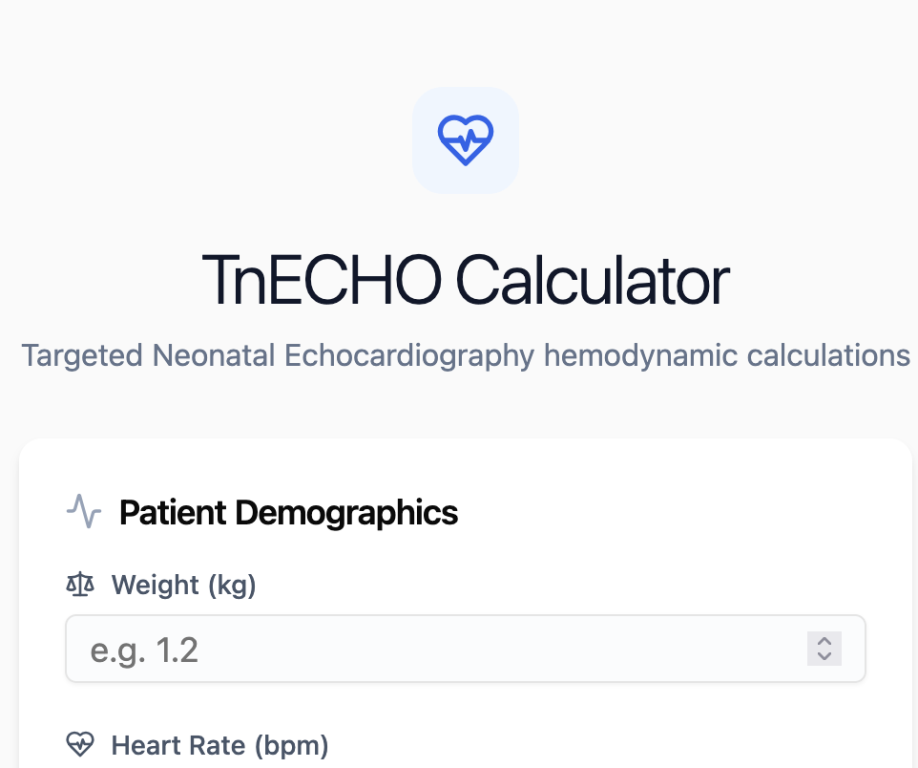 Thanks so much, really appreciate you taking the time to explore it and for the thoughtful feedback. Just to clarify, I’m the one who built the tool as part of my own clinical workflow in neonatal haemodynamics. It’s not intended as a standalone AI system, the calculations are rule-based, and the summary is generated from those inputs. You’ve raised a very important point about the summary being overly reassuring when data is incomplete, I completely agree. At the moment, missing inputs are not sufficiently accounted for, which can lead to overconfident statements. I’m working on improving this so that: missing parameters are explicitly flagged the interpretation reflects uncertainty and statements such as “cannot assess due to missing values” are included where appropriate The aim is to better reflect how we actually interpret TNE in practice, where a multi-parameter approach is essential and absence of data should never imply normality. I’ll also add a short section explaining who developed the tool and how it works, as I agree it currently feels a bit like a black box. Thanks again, this is exactly the kind of feedback I was hoping for. And yes, very happy for it to be featured or shared more widely.
 -
Hi everyone, I’ve been working on a simple web-based neonatal echocardiography (TNE) tool to support structured assessments and reporting during clinical practice. The aim is to: bring key measurements and calculations (e.g. outputs, E/A, E/E′, MPI) into one place standardise how I approach LV, RV, and PDA assessment and generate a concise, clinically meaningful summary at the end This is something I built primarily for my own workflow, but I’d really value feedback from others who do TNE. I’d be particularly interested in thoughts on: whether the structure reflects real-world TNE practice missing parameters or unnecessary ones how useful (or safe) automated interpretation might be and whether the generated summary feels clinically appropriate Thanks in advance!
-
-
-

View in the app
A better way to browse. Learn more.