_0b6494.png)
_5c07e1.png)
_0d1bd3.png)
_75149d.png)
.jpg.0241c805f885be5fcfba0a960300da57.jpg)
Everything posted by Vicky Payne
-
.png.9b23ba1d465ace21eabc427f3a6d1e9f.png) Our third NEOvations webinar series is on 14th March at 16:00 CET. Our last webinar saw attendees from 20 different countries so come and join the conversation! We have two guest speakers, Prof. Christoph Fusch, MD, PhD, discussing human milk bank analysis, and Dr. Joshua Bress, MD, who will be discussing the application of clinical decision support tools in the newborn nursery! As always, we will have a Q&A with our speakers. You can register here: https://zoom.us/webinar/register/7516762812433/WN_xKl0qAv0S_Ce_Ium6taYkA Prof. Christoph Fusch is Professor, Chair & Chief at University Children’s Hospital, Paracelsus Medical University, and Nuernberg General Hospital. He will be discussing human milk bank analysis. Dr. Joshua Bress is a neonatal hospitalist at California Pacific Medical Center, president of the nonprofit organization Global Strategies and medical director of the NoviGuide, a software platform for designing, deploying, and monitoring decision support algorithms. It was while living in Goma that he first developed an interest in how can we help clinicians follow rapidly evolving best practice guidelines for newborns globally and at scale? He has published multiple papers around the use of clinical decision support in newborn care, with a particular focus on the design and testing of safe clinical decision support systems. This webinar is sponsored by tech start-ups Miris AB (https://www.mirissolutions.com/) and NeoPrediX (https://www.neopredix.com/en/.
Our third NEOvations webinar series is on 14th March at 16:00 CET. Our last webinar saw attendees from 20 different countries so come and join the conversation! We have two guest speakers, Prof. Christoph Fusch, MD, PhD, discussing human milk bank analysis, and Dr. Joshua Bress, MD, who will be discussing the application of clinical decision support tools in the newborn nursery! As always, we will have a Q&A with our speakers. You can register here: https://zoom.us/webinar/register/7516762812433/WN_xKl0qAv0S_Ce_Ium6taYkA Prof. Christoph Fusch is Professor, Chair & Chief at University Children’s Hospital, Paracelsus Medical University, and Nuernberg General Hospital. He will be discussing human milk bank analysis. Dr. Joshua Bress is a neonatal hospitalist at California Pacific Medical Center, president of the nonprofit organization Global Strategies and medical director of the NoviGuide, a software platform for designing, deploying, and monitoring decision support algorithms. It was while living in Goma that he first developed an interest in how can we help clinicians follow rapidly evolving best practice guidelines for newborns globally and at scale? He has published multiple papers around the use of clinical decision support in newborn care, with a particular focus on the design and testing of safe clinical decision support systems. This webinar is sponsored by tech start-ups Miris AB (https://www.mirissolutions.com/) and NeoPrediX (https://www.neopredix.com/en/. -
We are delighted our last NEOvations webinar connected people from 20 countries! Can you identify all the flags?! We'd love to hear more from our members, so please connect in the comments and tell us more about you and where you work! And.....SAVE THE DATE for our next webinar on 14th March, 16:00 CET- more details to follow! We look forward to connecting, Posted on behalf of the 99NICU team who are reaching out from Sweden, Austria, United Kingdom and Finland!
-
The second of our FREE NEOvations webinar series is on 14th February 2023, 16:00-17:00 CET. This webinar is supported by the tech start-ups Monivent (https://www.monivent.se/) and Neola Medical (https://www.neolamedical.com/). The webinar will include two live sessions from our guest speakers, followed by audience Q&A. Our guest speakers are Prof. Gianluca Lista MD PhD, who will be speaking on “RDS & lung protective respiratory support” and Dr Chris Harris MD PhD, who will be speaking about “Prediction of outcomes using monitoring during resuscitation”. See more details on our guest speakers, below! Please sign up using the link: https://zoom.us/webinar/register/4016724100663/WN_t8v_9Y23T3-kDVV2K9W0Og We look forward to seeing you there! The 99NICU Team Prof. Gianluca Lista is a consultant neonatologist at V.Buzzi Children’s Hospital and an honorary Professor at the University of Milan. His PhD thesis, completed at Maastricht University in 2016, was titled “Respiratory management in the neonatal transitional phase: the role of sustained inflation to enhance non-invasive respiratory support”. His areas of interest are neonatal resuscitation; respiratory, and nutritional intensive care of very preterm infants, as well as neuroimaging and neurodevelopment of the newborn. He has more than 100 papers published on PubMed and is an active member of the ESPR. Dr Chris Harris is a consultant neonatologist at King’s College Hospital in London, and working as a researcher with King’s College London were he completed his PhD in neonatal ventilation and long term outcomes. As well as studies of resuscitation, Chris has also focused on the long term follow-up of the UKOS cohort and the benefits of providing neonatal care in Uganda. King’s NICU is a leading centre for neonatal respiratory medicine, led by Professor Anne Greenough.
-
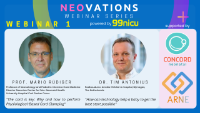 We are excited to announce that the 99NICU NEOvations webinar series will launch on Tuesday 10th January 2023, at 16:00-17:00 CET. For this webinar we are delighted to bring you two guest speakers, Prof. Mario Rüdiger who will be speaking on “The cord is key: Why and how to perform Physiological-Based Cord Clamping” and Dr. Tim Antonius, who will be speaking about “How can technology help a baby to get the best start possible”. Our aim is to host further NEOvations webinars in February, March and April 2023- watch this space for more information! Each webinar will be sponsored by a small tech-start up, with special guest lectures and Q&A. Please register for the webinar here. Guest speakers: Our first guest speaker is Prof Mario Rüdiger is professor of Neonatology and Pediatric Intensive Care Medicine and head of the Department for Neonatology and Pediatric Intensive Care Medicine at the Children’s Clinic of the University Hospital Carl Gustav Carus in Dresden. His clinical and scientific expertise covers mainly the following three topics: prevention of chronic lung disease in preterm infants, delivery room management and neonatal neuro-psychological development. He hosts the yearly Delivery Room Management symposium in Dresden at the beginning of March where distinguished speakers present the latest knowledge and research on delivery room management. Prof. Rüdiger has implemented the Concord Birth Flow in his department in Dresden in March 2021. Our second guest speaker is Dr. Tim Antonius, **MD (Radboudumc Amalia Children’s Hospital, Nijmegen, Netherlands) is a senior consultant in neonatal intensive care, ECMO specialist, a simulation expert and neonatal life support (NLS) course director. He is the inventor of the Parallel ECMO simulator and the ARNE (Augmented reality in neonatology) decision support device. This webinar is supported by tech start-ups Concord Neonatal (https://concordneonatal.com/) and ARNE (https://arne.health/)
 -
There is a module being run at London South Bank University aimed at caring for the neonate outside of neonatal units. There are accredited and non-accredited versions. This may be of interest to colleagues who work outside of the NICU. Please feel free to share. For more information you can contact: alysia.humphrey@gosh.nhs.uk External Accredited Module Poster '23.pdf External Non-accredited Module Poster '23.pdf
-
Like @AlexScrivensI have also used both. No real issues with either.
-
The WHO are launching their new preterm and low birth weight infant recommendations this Thursday 17th November, on World Prematurity Day. For more details, click on event info below:
-
The WHO are hosting a free webinar this THURSDAY 17th NOVEMBER to mark the launch of their recommendations for preterm and low birth weight infants, on World Prematurity Day. Register (and links to recommendations) below: https://www.who.int/news-room/events/detail/2022/11/17/default-calendar/launch-of-the-who-recommendations-for-care-of-the-preterm-or-low-birth-weight-infant Timings: 7am New York, 1pm Geneva, 3pm Kampala, 5.30pm New Delhi
-
The 99NICU team are excited to announce the launch of our new ”NEOvations" webinar series, about Ideas innovating the Future of Neonatal Care! This series will be centred around new technology start-ups in neonatology. The NEOvations webinars will include a short introduction by partnering companies, followed by short educational sessions by invited guest speakers, independent of the start-ups. These will be followed by an interactive Q&A discussion with the speakers. We hope that this webinar series will provide insight into new innovations in neonatal care, whilst enabling us to come together as a community to share our experiences & learning! The first webinar is due to launch in Jan 2023 - stay tuned for more information!
-
** Update** We have meeting room 127 booked from 20:00 at the conference venue. We plan to meet here first, before moving to a bar/social venue! 99NICU Geek Meetup Sunday 9th October, 20:00 Meeting room 127 at the conference venue See you there!
-
Hmm, I am not sure what you are referring to, sorry. Is it the CO2 sensors that change colour? Like these?? Or are you referring to something else? If CO2 caps then yes- these are considered routine in UK and pretty sure they are now recommended for all intubations to confirm ETT placement in trachea. If no colour change, likely oesophageal placement. However, can get false negatives: - low cardiac output states -if contaminated with fluid e.g. surfactant, drugs, gastric contents, secretions -if ETT inserted too far into one lung -severe obstruction e.g. meconium aspiration I really like them- simple, easy to use, and reduces errors in decision making/cognitive bias e.g. "no, my tube IS in the right place"---> "err, actually there is no colour change AND no chest movement- lets take the tube out and try again!" I hope that helps?

-
I can’t tell you how long we’ve used cefotaxime for- but definitely 10 years. You are best speaking to a colleague of mine for more details- if you want to message me your email address I can pass it on? Microbiology data monitored and I assume no concerns with ESBLs! second line fluclox and gent or vanc and gent if a central line present.
-
Yes- we would add in amoxicillin if concerns re: listeria. No aminoglycoside....
-
Cefotaxime first line for EOS in Southampton.
-
Nope not routinely, unless clinical concerns. I think our current guidance says to send the line tip if concerns but I also think we should be moving away from this practice- there is evidence that line tip cultures has very poor sensitivity and specificity has a diagnostic marker!!!
-
until
Join the VON webinar on blood transfusion practices to learn about guidelines for transfusions for high-risk infants and emerging evidence that may shift practices. It will discuss risks and benefits of current red blood cell transfusion practices, including concerns about NEC. Register here: https://public.vtoxford.org/qi-grand-rounds/ -
I liked the link here to the reporting of stats paper!! Some good points in here. Perhaps also the fact that skin cleaning is only one part of how central lines (and other invasive devices) may cause infection is also something to think about in this particular research area. Reducing colonisation good but transient....other practices are also likely to be important and may be different across all the studies included in a meta-analysis?
-
In my experience an extra loading dose isn’t given but as @kishoreyv17 says there is variation in dosing. Sometimes a dose of 7.5mg/kg twice a day is used! There could be an argument for checking caffeine levels to ensure they are in a therapeutic range before giving additional doses but I don’t think I’ve ever seen a caffeine level checked!!!!
-
Check out this paper which includes two of our speakers in our upcoming webinar on immediate kangaroo care for low birth weight infants. This might be an interesting pre-read for those of you attending the webinar on the 8th December! In fact, just an interesting read even if you are not attending! The concept of "birthday cuddles" immediately after birth (before transfer to a neonatal unit) is something being initiated in my local unit for our preterm babies.....And has been championed in other UK neonatal units. What about in your units?! Do you provide immediate skin to skin? Sign up below & join in the conversation: 2021 Kangaroo mother care.pdf
-
So the first thing is accuracy of X-rays at determining tip position and if the tip has genuinely migrated. the second would be securing and fixation as @Stefan Johanssonhighlights above. Some places place a stitch at the base of the cord as well so that as the cord shrinks and detaches, the catheter is till secure. Obviously this depends on how long the catheter stays in for. then third would be considering nursing aspects like handling, cuddles etc how much is the line under tension etc What we are seeing more of is central line extravasations- including abdominal extravastions of PN via UVCs. Anyone else experiencing this? Could it be related to PN composition?
-
Also no and no! At most we would use 7.5mg/kg BD in individual cases but standard dose is 10mg/kg OD. We do not measure caffiene levels. Though when we get all concerned about tachycardia I do wonder about what the level might be!
-
In our unit we categorise our babies into high-risk, medium-risk and low-risk for nutritional management of PN and enteral feeding. High risk, severe IUGR with absent or reversed EDF babies would be 10-20mls/kg/day. We also have guidance about how to manage abdominal distension and aspirates- but there is a definite movement in the research community around stopping "routine" checking of gastric residuals....
-
Good question re: LOS! I think we probably still would i.e if clinical suspicion was low with negative laboratory parameters e.g. WCC and CRP (though more like 48 hours than 36 perhaps...), but if laboratory parameters are concerning, maybe 5 days with a negative culture...... And I also like the Cantey commentary- nice share! There is some suggestion that prolonged duration of EOS antibiotics for 'culture negative sepsis' in preterms is associated with increased risk of LOS... https://www.tandfonline.com/doi/full/10.1080/14767058.2018.1481042?casa_token=Opk-yk6TMrgAAAAA%3AzNoO9exu3ovIVBe20ZfN2HXJyPVMhVyT_TiY_J7edvdc-cjBIED-COC5Lu-GyhcRzIvVU8jnYt0
-
Webinar on the role of the neonatal behaviour assessment scale (NBAS) and newborn behavioural observations (NBO) in the neonatal unit. See more information here: https://nna.org.uk/events/
-
Calling all nurses on the NICU! Please see below for opportunities to apply for travel/education/research scholarships! https://nna.org.uk/scholarship/?fbclid=IwAR2tbRBT4yV7O8E3U7RwF3_kBAmqJnxSHIHvQ7SbPMW5UXlQSbBSYtSI93g
.thumb.jpg.9337b79d733812b332433aa8f037f9b8.jpg)