
_0b6494.png)
_5c07e1.png)
_0d1bd3.png)
_75149d.png)

Everything posted by Stefan Johansson
-
-
Actually, I think there is a placebo-contr trial in the pipelines within the NICHD network (over there).
-
Would be great with a pharmacologist on board! Let's talk when we meet
-
The AAP committee on fetus and newborn has released its clinical report on PDA in the preterm infant, and it is available on http://pediatrics.aappublications.org/content/early/2015/12/13/peds.2015-3730 It is a short and well-written report. I especially like the headline "Clinical Trial Opportunities" and the following paragraph stressing that "systematic evaluation in clinical trials...are urgently needed to guide management of these infants". In addition to establishing causal effects of ductal shunting, we need to learn much more about benefits and harms related to our current interventions. Highly recommended reading!
-
Unfortunately.
-
Maybe you could find those forms here: https://www.npeu.ox.ac.uk/toby Otherswise you could probably contact the study team here: https://www.npeu.ox.ac.uk/toby/contact
-
 First and foremost - I would like to wish you the best for the upcoming New Year 2016! During 2015, I think 99nicu thrived really well. Especially memorable moments were: our first virtual journal club the comeback of the 99nicu Polls plenty of great blog posts from Keith Barrington and Michael Narvey our upgrades that resulted in a great new interface (finally fully responsive on mobiles), made possible by educational grants from Acta Paediatrica and the ROP trial. our sharing of the Orphan-Europe webcast on PDA echo assessment For 2016, I hope 99nicu reaches its full potential as the busy community needed by professional in neonatal medicine. This is what I personally think about for 2016: future journal clubs, (next is scheduled 12 January) more active discussions in the forums more blogs (email me on info@99nicu.org if you need help to start a blog) a crowd-sourced Pharmacopedia (Neonatal Formulary) the 99nicu 10year anniversary, in May 2016! New Years Greetings from the early frosty winter in Stockholm! Stefan Johansson, MD PhD
 -
-
While we aim for prenatal transfer to level-3 units (when applicable, for example, in birth <28 weeks, antenatally diagnosed hydrops etc) we sometimes end up with a critically ill infant in our level-2 unit. Most of us have previously worked in level-3 settings so the initial management with stabilization is similar regardless of initial level-of-care. We have a good communication with our regional level-3 unit (at Karolinska hospital) and discuss those cases carefully over the phone, and reach consensus what to do. And naturally, also involving the parents of course! Usually it is possible to aim for a postpartum transport, but sometimes further treatment is judged as futile. I agree with @dracunculus that decisions are really taken on an individual basis.
-
 We have set the date for the next Journal Club to Tuesday 12 January 2016, at 7 PM (GMT). The topic this time is outcomes of infants with Apgar score of zero at 10 min. Commonly guidelines are that resuscitation may be stopped if an infant is till asystolic by 10 min of age and despite adequate resuscitative efforts. However, an interesting case series published in ADC concluded that a relatively large proportion of infants surviving despite Apgar score of zero at 10 minutes had a normal neurological assessment on follow-up. The report is accompanied by an interesting editorial. Both articles are available as Editor's Choices at the ADC web site: http://fn.bmj.com/content/100/6/F492.full http://fn.bmj.com/content/100/6/F476.full ADC also produced a podcast that you can listen to here: https://soundcloud.com/bmjpodcasts/how-long-should-resuscitation-continue-at-birth-in-the-absence-of-a-detectable-heartbeat Please read those articles and join the Journal Club in the Chat room. Note that you need to log in to enter the chat room.
 -
-
 We would like to invite all our members to join a short survey on parenteral vitamin A, as a preventive therapy against BPD in preterm infants. We are distributing the survey on behalf of Orphanix, an Austrian start-up company that is developing innovative medicines with a strong focus on neonatology. In return Orphanix will support 99nicu with an educational grant for 2016, a mostly welcome contribution! Please use this URL to complete the survey: https://www.surveymonkey.com/r/W8JG8BR
 -
Tell the ophtalmologist - you got to see it to believe it! If you get permission/consent from parents - it would be great to share a photo around here. Maybe someone would not just bring some more confusion, like me...
-
Interesting observation! Do you mean that the opthalmologist did not see the same at all or just did not have a name for it? I have some vague memories that there are more pigmentforming during the embryonic period - maybe this is some sort of overpigmentation remnant from fetal life?? Maybe you finns some clues here? http://www.ncbi.nlm.nih.gov/m/pubmed/3507670/
-
We got an interesting comment from @AllThingsNeonatal after the announcement on "Home" - I quote it ************** I think what this shows is that this particular strain of probiotics is ineffective. Herein lies the problem with the huge glut of info on probiotics and that is the wide variation in products that have used. I suspect probiotics will not help all premature infants but rather a subset which we have yet to identify. Add to this that so few centres are comparing the same bacteria and it is no wonder the results are inconsistent. Based on the work being done here in Manitoba on the infant microbiome (see work by Meghan Azad) it is clear that not only do the bacterial genus and species matter but whether they are active and to what extent that influences health. I am not sure how we will ever settle the probiotic discussion but it may become entirely moot as we expand donor breast milk programs which I think is the better way to go.
-
The awaited probiotics UK-trial is now published, and the results are showing that a single bacteria (Bifidobacterium breve BBG-001 in very preterm infants) does not reduce the risk of NEC, late-onset sepsis, or mortality. http://www.thelancet.com/journals/lancet/article/PIIS0140-6736(15)01027-2/abstract In short, a negative trial of good quality methodologically. However, the results contrasts against the ProPrems trial, similarly powered and well-designed, but the probiotics in that trial included a 3-strain preparation: http://pediatrics.aappublications.org/content/early/2013/11/12/peds.2013-1339 Another upcoming paper in Acta Paediatrica from Berlin on a 2-strain probiotics also showed benefits: http://onlinelibrary.wiley.com/doi/10.1111/apa.13280/abstract My question to you how you interpret all these findings, also in the light of the Cochrane review from last year, which expressed strong conclusions that probiotics should be offered to preterm infants. (here: http://www.ncbi.nlm.nih.gov/pubmed/24723255) Do you, or don't you use probiotics? Why? Please share your own experiences. If you use probiotics, please also share what type of probiotics you use.
-
-
 So, our first JC ever is over. Three people from Sweden, India and Iran met up to discuss two papers on PDA. Despite the small group, I think it was a great experience to sort-of meet IRL, although there is room for improvements, also on the technical side. I add a transcript from the Chat room below. ****************************** Stefan Johansson ** getting ready ** Welcome to the 1st 99nicu Journal Club Tonight we are going to discuss a paper previously publ in ADC: http://fn.bmj.com/content/100/1/F55.full.pdf+html on the "Natural evolution of patent ductus arteriosus in the extremely preterm infant" ** patiently awaiting others to join... ** Stefan JohanssonHi Selvan! How are you?@Selvan - seems that we are not attracting a crowd @amirmasoud2012! Welcome here! amirmasoud2012 hello selvanr4 yes stefan .it is day one . wait for sometime Stefan Johansson Shall we start? Did you read the ADC paper on spontaneous PDA closure? If so, what was your general impression? selvanr4 yes. paper questions the need for treatment to close pda since around 70% pda close on their own amirmasoud2012 It was interesting ... the more we were treated .... Stefan Johansson PDA's are a tricky business. Interesting that the unit (in the study) did not treat PDA's at all (with drugs)But I think the rate of spontaneous closure is a mistake... they should have included all infants "at risk", i.e. also those who died, in the denominator. But still, the spont closure rate would be around 55-60% if all infants were included What is your practises regarding PDA therapy? selvanr4 yes stefan you are correct .they have excluded babies who died.and within 72 hrs . but still 55-60 good number we treat if they are symptamatic Stefan Johansson We do the same. But I think our general view has changed - to a more conservative approach amirmasoud2012 Better if we treat the unstable situation ... modrate to large size pda 18:26 Stefan Johansson @amir - I agree. A major difficulty with PDA's is that some tiny babies are severly affected (say a 24w on mech ventilation), while other more mature preterm do just fine without tx (like a 31w on CPAP) selvanr4 i heard from my friend who has worked in cardiff saying they have used it very rarely. amirmasoud2012 can you accept the risk of no treatment? Stefan Johansson I would be very hesitant NOT to give a significant shunt. I am a PDA-believer Did you manage to get hold on the other paper in JAMA - about early echo and its benefits? In fact - that paper oppose the ADC paper - that there are benefits with early investigation (less lung bleeds for example) selvanr4 i just read the abstract. as you said it is for early echo! i could not get full paper 18:33 amirmasoud2012 I remember I do not have to search again Stefan Johansson But it is a bit strange (the JAMA paper) - because they use timing of echo as a proxy for treatment. selvanr4 It will be difficult for me to keep my hands tied when you see a significant pda Stefan Johansson Actually, I have heard know of plans in the US (within the NICHD trial network) that they will make a placebo-controlled (blinded) RCT. Meaning they will give NSAID or placebo to treat a duct...Very difficult trial, and complicated with cross-overs in case a baby really need to close the duct selvanr4 An early PDA is not always a benign entity- did you read the rapid response? An early PDA is not always a benign entityMartin R Kluckow, Neonatologist Nick Evans, Sydney University We read with interest the article by Rolland et al regarding a retrospective natural history study of the PDA in a cohort of preterm infants in a unit which conservatively managed the presence of a PDA after 24 hours(1). We have concerns about the data analysis and the conclusions drawn. In particular we question the decision to exclude... Stefan Johansson Nick Evans is my principal mentor in PDA-thinking This is a good conclusion! "Concluding from the data presented that the exposure to the risk of therapeutic intervention to close a PDA is not warranted based on spontaneous closure rates of a selected surviving sub-group is not justified." selvanr4 Nice argument Stefan Johansson In short, I think Kluckow and Evans want to say that the ADC study is crap selvanr4 yes stefan amirmasoud2012 selvanr4 what do feel is a best model to study the natural evolution of pda Stefan Johansson I think the best way would be to make serial echos on a prospective cohort. In fact I think Kluckow and Evans have done thatand showing that severe early shunts is associated with lung bleeds and IVH (really significant and bad things) amirmasoud2012 Our third day we echo And before the third day if not treated pda . Stefan Johansson @amir - generally do the same, but in very instable babies our guidelines is echo typically on 1-2 day of life Stefan Johansson @amir and @selvan - my time is out now it was great chatting with you despite some techn problems selvanr4 thanks stefan amirmasoud2012 thanksgood idea selvanr4 thanks amir Stefan Johansson I think we need to think about how we use the chat room in the future i.e. the technical side. I hope we meet again here selvanr4 can we have offline postings? amirmasoud2012 Keep going in the future Stefan Johansson @selvan - I will try to copy & paste the conversation into a word doc and then add it on the web site selvanr4 yes . hoping for the best Stefan Johansson We keep in touch! Ciao!
 -
So, our first JC ever is over. Three people from Sweden, India and Iran met up. Despite the small group, I think it was a great experience to sort-of meet IRL. I add a transcript from the Chat room below. ****************************** Stefan Johansson ** getting ready ** Welcome to the 1st 99nicu Journal Club Tonight we are going to discuss a paper previously publ in ADC: http://fn.bmj.com/content/100/1/F55.full.pdf+html on the "Natural evolution of patent ductus arteriosus in the extremely preterm infant" ** patiently awaiting others to join... ** Stefan Johansson Hi Selvan! How are you? @Selvan - seems that we are not attracting a crowd @amirmasoud2012! Welcome here! amirmasoud2012 hello selvanr4 yes stefan .it is day one . wait for sometime Stefan Johansson Shall we start? Did you read the ADC paper on spontaneous PDA closure? If so, what was your general impression? selvanr4 yes. paper questions the need for treatment to close pda since around 70% pda close on their own amirmasoud2012 It was interesting ... the more we were treated .... Stefan Johansson PDA's are a tricky business. Interesting that the unit (in the study) did not treat PDA's at all (with drugs) But I think the rate of spontaneous closure is a mistake... they should have included all infants "at risk", i.e. also those who died, in the denominator. But still, the spont closure rate would be around 55-60% if all infants were included What is your practises regarding PDA therapy? selvanr4 yes stefan you are correct .they have excluded babies who died.and within 72 hrs . but still 55-60 good number we treat if they are symptamatic Stefan Johansson We do the same. But I think our general view has changed - to a more conservative approach amirmasoud2012 Better if we treat the unstable situation ... modrate to large size pda 18:26 Stefan Johansson @amir - I agree. A major difficulty with PDA's is that some tiny babies are severly affected (say a 24w on mech ventilation), while other more mature preterm do just fine without tx (like a 31w on CPAP) selvanr4 i heard from my friend who has worked in cardiff saying they have used it very rarely. amirmasoud2012 can you accept the risk of no treatment? Stefan Johansson I would be very hesitant NOT to give a significant shunt. I am a PDA-believer Did you manage to get hold on the other paper in JAMA - about early echo and its benefits? In fact - that paper oppose the ADC paper - that there are benefits with early investigation (less lung bleeds for example) selvanr4 i just read the abstract. as you said it is for early echo! i could not get full paper 18:33 amirmasoud2012 I remember I do not have to search again Stefan Johansson But it is a bit strange (the JAMA paper) - because they use timing of echo as a proxy for treatment. selvanr4 It will be difficult for me to keep my hands tied when you see a significant pda Stefan Johansson Actually, I have heard know of plans in the US (within the NICHD trial network) that they will make a placebo-controlled (blinded) RCT. Meaning they will give NSAID or placebo to treat a duct... Very difficult trial, and complicated with cross-overs in case a baby really need to close the duct selvanr4 An early PDA is not always a benign entity- did you read the rapid response? An early PDA is not always a benign entity Martin R Kluckow, Neonatologist Nick Evans, Sydney University We read with interest the article by Rolland et al regarding a retrospective natural history study of the PDA in a cohort of preterm infants in a unit which conservatively managed the presence of a PDA after 24 hours(1). We have concerns about the data analysis and the conclusions drawn. In particular we question the decision to exclude... Stefan Johansson Nick Evans is my principal mentor in PDA-thinking This is a good conclusion! "Concluding from the data presented that the exposure to the risk of therapeutic intervention to close a PDA is not warranted based on spontaneous closure rates of a selected surviving sub-group is not justified." selvanr4 Nice argument Stefan Johansson In short, I think Kluckow and Evans want to say that the ADC study is crap selvanr4 yes stefan amirmasoud2012 selvanr4 what do feel is a best model to study the natural evolution of pda Stefan Johansson I think the best way would be to make serial echos on a prospective cohort. In fact I think Kluckow and Evans have done that and showing that severe early shunts is associated with lung bleeds and IVH (really significant and bad things) amirmasoud2012 Our third day we echo And before the third day if not treated pda . Stefan Johansson @amir - generally do the same, but in very instable babies our guidelines is echo typically on 1-2 day of life Stefan Johansson @amir and @selvan - my time is out now it was great chatting with you despite some techn problems selvanr4 thanks stefan amirmasoud2012 thanks good idea selvanr4 thanks amir Stefan Johansson I think we need to think about how we use the chat room in the future i.e. the technical side. I hope we meet again here selvanr4 can we have offline postings? amirmasoud2012 Keep going in the future Stefan Johansson @selvan - I will try to copy & paste the conversation into a word doc and then add it on the web site selvanr4 yes . hoping for the best Stefan Johansson We keep in touch! Ciao!
-
I'd suggest you contact ESN http://esn.espr.info/
-
I guess many of you have read the interesting article in NEJM about Between-Hospital Variation in Treatment and Outcomes in Extremely Preterm Infants , and the great editorial by Neil Marlow on the Elephant in the Delivery Room. In short, the research article showed that NICUs (in the US) being more pro-active in resuscitating 22week-infants had a greater survival and better outcomes than those NICUs that were more restrictive to act after deliveries at 22 (completed) weeks. However, even in "active" NICUs mortality was 77% at 22 weeks, as compared to 95% in "passive NICUs. And survival without major impairment was 15% and 3% in active and passive NICUs, respectively. In Sweden, we currently have no national consensus on how to approach infants born at 22 weeks, "active" and "passive" strategies are both being promoted in different regions. And, as gestational age is also a non-exact figure, there is also a recent debate whether infants "around 22 weeks" (typically late 21 weekers) should be resuscitated, as those infants "true" gestational age could be ≥22 weeks. Have the NEJM-paper above resulted in revisions of local/regional/national guidelines? Do you have ongoing ethical discussions about the limit of viability? To what degree is this discussion run by the NICU community, and how much are parental organisations and other laymen contexts involved? It would be great to hear about the discussions within other countries with different levels of resources. What is considered the "actual" gestational week that is the limit of viability is not so much the focus of my thoughts, but rather the principal discussions behind decision-making.
-
Hello, I don't have a good answer but I think there are some things more important than others. Like Japan we have almost full coverage of antenatal care (free service for all). About 95% of pregnancies are ultrasound-dated, i.e. we have a uniform estimate of gestational age. Obstetric and neonatal services are fairly well "coordinated" and available to all. Level-3 NICU care is centralized to (7?) regional/university hospitals and the vast majority small infants are transferred in utero to their level-3 hospital. And, we have a relatively low proportion of really socially disadvantaged parents. Apart from that we also have a tradition of non-invasive ventilation (nCPAP) also in tiny infants - I am not sure but it is likely this was a strategy that was developed due to less staffing and budgets initially... The National Board of Health issued national guidelines recently on some key topics: those are only available in Swe though.... but here they are: http://www.socialstyrelsen.se/publikationer2014/2014-9-10 However, I think there is a greater room for improvements in Sweden: we don't use probiotics our transportation services are rather regional "initiatives" than a results of a national strategy there are no national consensus whether 22-weekers should be resuscitated we could still "do less" of things that lack evidence but has potential side-effects we need to combat nosocomial infections better Most importantly, despite the structure of care/society that enables really large observational studies (we can track /link individual data from birth to death, data in several national registries), we do hardly no intervention research. Greetings from Sweden
-
I think the main idea behind world prem day is to promote the message on preterm birth to the public. Here in Sweden, the 17th of Nov is still a relatively small event, but increasing. There are two events, one in Stockholm and one in Gothenborg, where preterm birth is discussed in a great context: what can we achieve, what resources are needed for care, and for children's special needs later in life, parental involvement, NICU design etc-etc. So, having said that, it all depends on the audience. And if you plan an "in-hospital" event, with staff mainly, I think your themes are great! Maybe you can find some good material on the web sites like the WHO and March of Dimes.
-
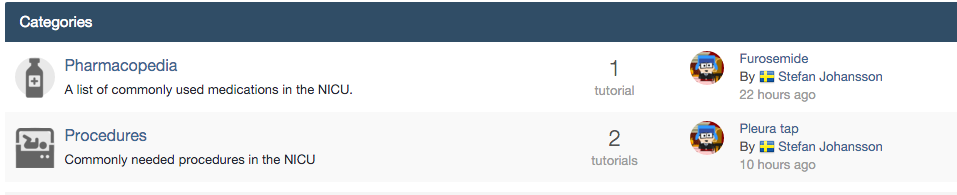
@mahatma the old idea has come to life and I think we really should give it a try. Once I feel the plugin is configured as needed I will start a new thread about the idea, and how we can get this going. For example, I think would need a small editorial board for a eHandbook. And I attach a screenshot as a cliff-hanger...
-
 Now you can tweak your signature by adding your country flag! The flag will be displayed before your name, like the Swedish flag is seen before my name. Just login, and in the right upper corner, choose "Account settings", and click on the "Country" tab there. Done!


until