_0b6494.png)
_5c07e1.png)
_0d1bd3.png)
_75149d.png)

Everything posted by Stefan Johansson
-
For #1 - from a pathophys view (decreasing pulm vascular resistance is the key goal) so iNO would certainly be my option. For #2 - given a completely well infant at 24h, we would be OK with discharge at 24h.
-
From Tw:
-
 I am very glad to welcome Concord Neonatal as our latest Supporting Bronze Partner. Concord Neonatal is a pioneering neonatal care company. They provide the Concord Birth Trolley® , enabling neonatal caregivers to provide lifesaving care with the umbilical cord intact for as long as needed. Close to mom, the baby gets maximum benefit from the blood from the placenta, up to the moment it is breathing on its own. We are very happy for this partnership. With its unrestricted educational grants to 99nicu, Concord Neonatal will help us cover costs for maintenance, development and technical support of 99nicu. As "there is no free lunch", we are very thankful for this financial support. Also check out the other Partners on our Partner Page.
 -
-
-
-
As calcium varies by pH, I find it myself a bit tricky to interpret levels in asymtomatic babies. as we get ion Ca on our blood gases, that is what we usually assess. here is a relatively good web page with normal reference values: https://www.bettersafercare.vic.gov.au/resources/clinical-guidance/maternity-and-newborn-clinical-network/normal-laboratory-values-for-neonates
-
In milder hyponatremia (due to increased losses common in preterm infants) we typically supplement orally with NaCl and start with 4mmol Na/kg/day, split into four doses/24h (so 1 mmol Na/kg/dose x 4). In cases of higher losses (like use of thiazid diuretic) one needs to supplement more, sometimes we end up with ~10 mmol Na/kg/day Found this protocol from the UK, we do similary: http://mm.wirral.nhs.uk/document_uploads/shared-care/SodiumChloridesharedcare guideline14.pdf
-
I’d say it depends on the underlying pathogenesis. If the reason is iatrogenic or true Na loss. Generally we aim to correct S-Na during 12-36 hours. We calculate the sodium deficit and administrer that amount during this time. We do never use undiluted sodium solution, always add to a larger volume (typically 8 or sometimes 16 mmol/L)
-
 Join our webinar - Unpicking the evidence for nurse staffing in the NICU: What is optimal and what is the impact? With two leading experts in this field, Chiara Dall’Ora at the University of Southampton / UK, and Eileen T. Lake at the University of Pennsylvania School of Nursing / US. Bookmark Wednesday 14 October 16:00 CET. You can register for the event here. Many of our 99NICU subscribers will have experienced first-hand the challenges of staffing the NICU, being aware of the short-term impact nurse staffing can have both on patient care and staff morale. During this 2nd 99NICU Webinar, we will explore the wider impact of nurse staffing on patient outcomes and review what the evidence suggests are potential strategies for optimising staffing. Supported by the latest research from experts in their field, we encourage you to interact with our speakers with a live Q&A session. We look forward to welcoming you to the 2nd 99NICU webinar! Speakers Chiara Dall’Ora is a lecturer at the University Of Southampton. Her research mainly entails designing and performing large workforce studies using quantitative routinely collected data, focusing in particular on nurses’ shift patterns and staffing levels. Chiara qualified as a Registered Nurse in Italy and, after pursuing a MSc in Nursing and Midwifery Sciences, she completed her PhD within Health Sciences in 2017. Eileen Lake has made a significant impact on nursing care practice through research on clinical work environments and nurse staffing levels in hospitals. She currently is a professor of nursing and sociology, the Jessie M. Scott Endowed Term Chair in Nursing and Health Policy, and associate director of the Center for Health Outcomes and Policy Research at the University of Pennsylvania School of Nursing. Eileen Lake has developed a foundational measure/index of nursing care performance to demonstrate nursing’s impact on patient outcomes. This index provides scientific evidence that health care settings that capitalize on nurses’ education and skills achieve higher quality outcomes.
 -
Hi! I don’t have any personal experience but only know this can be a challenging problem. Did a search through Google Scholar , maybe you find some relevant references/ case reports here: https://scholar.google.se/scholar?q=bronchopleural+fistula+management+preterm&hl=sv&as_sdt=0&as_vis=1&oi=scholart
-
@Peter Odion Ubuane The cooling trial in Australia was done with a low-tech solution, they used regular cooling "gel packs". If I remember correctly from a lecture long ago, they sometimes also used a table fan bedside, if they had problems to reach the target temp. I found this photo below and local trial info on the web here: https://www.bettersafercare.vic.gov.au/resources/clinical-guidance/maternity-and-newborn-clinical-network/therapeutic-hypothermia-for-hypoxic-ischaemic-encephalopathy-initiation-in-special-care-nurseries The trial publication is available free in full-text here: https://jamanetwork.com/journals/jamapediatrics/fullarticle/1107569
-
(Another) Great video! Many thanks for sharing!
-
We don’t use non-invasive NO so the poll does not work out well for me (required fields / questions are based on Yes in the first question)
-
👍 thanks for sharing and congratulations to you and your team! Keep up the good work!
-
-
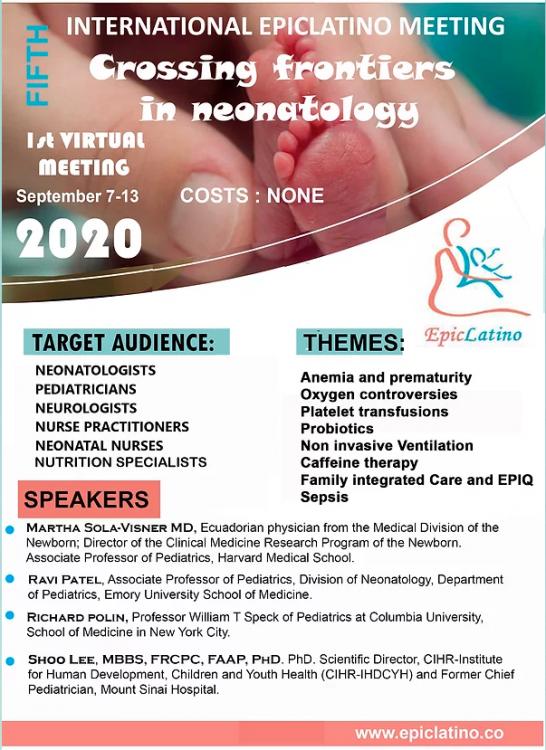
Check out the , now for the first time as a Virtual Meeting. More info on the attached PDF. Visit the web site for more info and to register: https://www.epiclatino.co/in-english
-
until
Check out the 5th International Epiclatino Meeting - "Crossing Frontiers in Neonatology", now for the first time as a Virtual Meeting. More info on the attached PDF. Visit the web site for more info and to register: https://www.epiclatino.co/in-english -
-
-
We sometimes culture infants for herpes simplex born through a normal vaginal delivery and maternal herpes simplex is discovered late during or after delivery (typically recurring herpes). In case of a positive herpes PCR, for example in the upper airway, but negative PCR in blood and cerebrospinal fluid - how would you outline management How do you reason around "colonization" vs "infection" with herpes simplex? My experience over the years, is that a more active management are now adviced from our virology consultants, i.e. iv acyklovir for a relatively long time period.
-
More from Twitter! @Aedi Budi Dharma - as reply to your question about blood products, we don't use PICC lines for plasma or blood, the lumen of our PICC lines would clot.
-
We practically only use our PICC lines for parenteral nutrition. The small diameter (28G) only makes it possible to infuse only.
-